Mixed-Data Sampling Quantile Regression (MIDAS-QR) for Nowcasting Indonesia’s Economic Growth-at-Risk of Non-Oil and Gas Processing Industry Sector
DOI:
https://doi.org/10.22452/mjs.vol45sp2.11Keywords:
GaR, MIDAS-QR, FCI, GDP GrowthAbstract
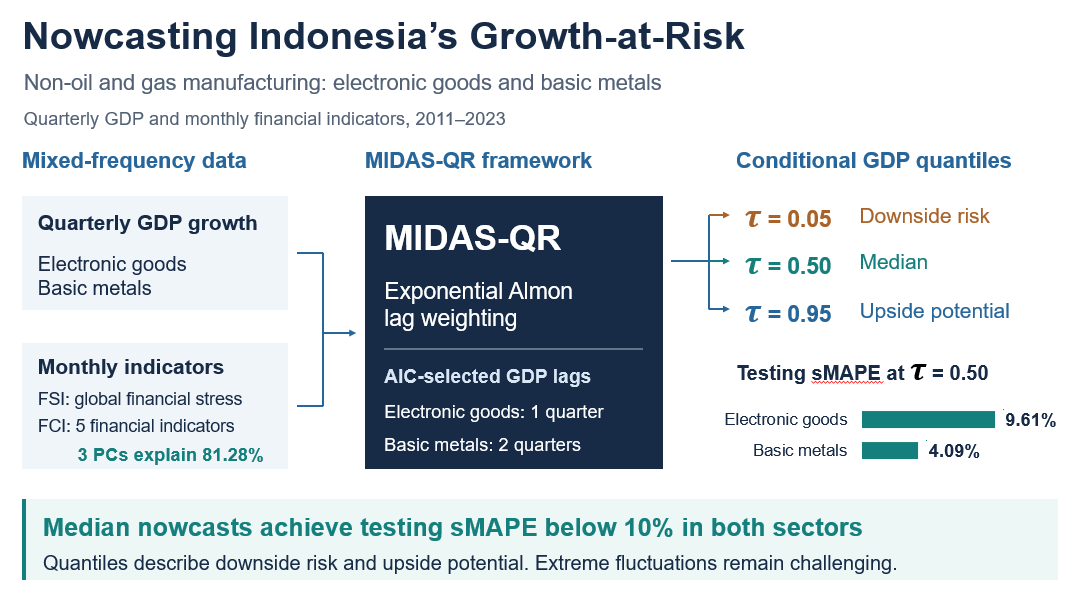
The non-oil and gas processing industry plays a vital role in economic stability, making timely Gross Domestic Product (GDP) nowcasting essential for managing economic fluctuations and shaping effective macroeconomic policies. This study applies the Mixed Data Sampling Quantile Regression (MIDAS-QR) model to nowcast GDP growth in the non-oil and gas processing industry, a key driver of economic stability. By integrating high-frequency financial indicators, such as the Financial Stress Index (FSI) and Financial Condition Index (FCI), derived through principal component analysis, the model effectively captures non-linear patterns using an Exponential Almon Lag Polynomial function. Covering data from January 2011 to December 2023, the MIDAS-QR model demonstrates strong predictive accuracy, particularly in the electronic goods and basic metals sectors. The best performing model for nowcasting is found in the median quantile (τ = 0.5), which produces the smallest error in both the electronic goods and base metals sectors. This is because the median value tends to be closer to the actual value than the other quantiles. The symmetric Mean Absolute Percentage Error (sMAPE) value in the training data for the electronic goods sector is 7.32% and testing is 9.16%, while for the base metal sector, the sMAPE value in the training data is 5.21% and testing is 4.09%. These findings enhance Growth-at-Risk (GaR) assessments, providing policymakers and industry leaders with critical insights for navigating economic uncertainties and shaping effective macroeconomic policies.
References
Eurostat. (2016). Overview of GDP Flash Estimation Methods. In Overview of GDP flash estimation methods. Luxembourg: Publications Office of the European Union.
Fastasima, B., Zaharani, H. H., Widodo, W. U., & Kiky Aprianto, N. E. (2025). Peran Kebijakan Pemerintah Dalam Mendorong Pertumbuhan Industri. Jurnal Riset dan Publikasi Ilmu Ekonomi, 3, 50-60.
Ferrara, L., Mogliani, M., & Sahuc, J. G. (2020). High-Frequency Monitoring of Growth-at-Risk. CAMA : Centre for Applied Macroeconomic Analysis.
Ghysels, E., Clara, P. S., & Valkanov, R. (2004). The MIDAS Touch: Mixed Data Sampling Regression Models. Department of Economics University of North Carolina.
Ghysels, E., Clara, P. S., & Valkanov, R. (2005). There is a Risk-Return Trade-Off After All. Journal of Financial Economics, 76, 509–548.
Ghysels, E., Kvedaras, V., & Zemlys, V. (2016). Mixed Frequency Data Sampling Regression Models: The R Package Midasr. Journal of Statistical Software, 72(4).
Hu, H., Zhao , C., Li, J., & Huang, Y. (2022). Stock Prediction Model Based on Mixed Fractional Brownian Motion and Improved Fractional-Order Particle Swarm Optimization Algorithm. Fractal and Fractional, 6, 1-20.
Koenker, R. (2017). Quantile Regression: 40 Years On. Centre for Microdata Methods and Practice (cemmap).
Koenker, R., & Bassett, G. (1978). Regression Quantiles. Econometrica, 46 No.1, 33-50.
Kuzin, V., Marcellino, M., & Schumacher, C. (2011). MIDAS vs. Mixed-Frequency VAR: Nowcasting GDP in the Euro Area. International Institute of Forecasters, 27, 529-542.
Ma'Arif, S. (2019). Nowcasting Pertumbuhan Produk Domestik Bruto Indonesia Menggunakan Dynamic Factor Model. In Nowcasting Pertumbuhan Produk Domestik Bruto Indonesia Menggunakan Dynamic Factor Model. Surabaya: Tesis Institut Teknologi Sepulih Nopember.
Makridakis, S., & Hibon, M. (2000). The M3-Competition: Results , Conclusions and Implications. International Journal of Forecasting, 16, 451-476.
Rantini, D., Octavanny, M. A., Kruba, R., Kuswanto, H., & Fithriasari, K. (2018). Quantile Regression Neural Network Model for Forecasting Consumer Price Index In Indonesia. Inferensi, 1(1), 39-43.
Saputra, W. H., Prastyo, D. D., & Kuswanto, H. (2024). Machine Learning Modeling on Mixed-frequency Data for Financial Growth at Risk. Procedia Computer Science, 234, pp. 397-403.
Saulo, H., Vila, R., & Borges, G. (2023). Modeling Income Data via New Parametric Quantile Regressions: Formulation, Computational Statistics, and Application. Mathematics, 11(2), 1-25.
Sujianto, A. E. (2024). Analisis Penentuan Produk Domestik Bruto Atau Gdp (2 Sektor). Neraca Manajemen Ekonomi, 5 No.8, 1-10.
Supriyatna, P. K., Prastyo, D. D., & Akbar, M. S. (2024). Application of the Dynamic Factor Model on Nowcasting Sectoral Economic Growth with High-Frequency Data. Media Statistika, 17(2), 128-139.
Tsay, R. S. (2010). Analysis of Financial Time Series. USA: Wiley.
Utari, D. T., & Rosadi, D. (2018). Forecasting Indonesian GDP Growth using Mixed Data Sampling (MIDAS) Regression. International Seminar on Innovation in Mathematics and Mathematics Education. Yogyakarta.
White, H., & Kim, T. -H. (2015). VAR for VaR: Measuring Tail Dependence Using Multivariate Regression Quantiles. Journal of Econometrics, 187, 169-188.
Xu, M., Xu, Q., Jiang, C., & Zhuo, X. (2023). Mixed-frequency Growth-at-Risk with the MIDAS-QR Method : Evidence from China. Economic Systems, 47.
Xu, M., Xu, Q., Jiang, C., & Zhuo, X. (2025). High Frequency Growth at Risk of China: the Role of Macro financial Environment. Computational Economics.
Downloads
Published
Issue
Section
License
Copyright (c) 2026 Malaysian Journal of Science (MJS)

This work is licensed under a Creative Commons Attribution-NonCommercial 4.0 International License.
Transfer of Copyrights
- In the event of publication of the manuscript entitled [INSERT MANUSCRIPT TITLE AND REF NO.] in the Malaysian Journal of Science, I hereby transfer copyrights of the manuscript title, abstract and contents to the Malaysian Journal of Science and the Faculty of Science, University of Malaya (as the publisher) for the full legal term of copyright and any renewals thereof throughout the world in any format, and any media for communication.
Conditions of Publication
- I hereby state that this manuscript to be published is an original work, unpublished in any form prior and I have obtained the necessary permission for the reproduction (or am the owner) of any images, illustrations, tables, charts, figures, maps, photographs and other visual materials of whom the copyrights is owned by a third party.
- This manuscript contains no statements that are contradictory to the relevant local and international laws or that infringes on the rights of others.
- I agree to indemnify the Malaysian Journal of Science and the Faculty of Science, University of Malaya (as the publisher) in the event of any claims that arise in regards to the above conditions and assume full liability on the published manuscript.
Reviewer’s Responsibilities
- Reviewers must treat the manuscripts received for reviewing process as confidential. It must not be shown or discussed with others without the authorization from the editor of MJS.
- Reviewers assigned must not have conflicts of interest with respect to the original work, the authors of the article or the research funding.
- Reviewers should judge or evaluate the manuscripts objective as possible. The feedback from the reviewers should be express clearly with supporting arguments.
- If the assigned reviewer considers themselves not able to complete the review of the manuscript, they must communicate with the editor, so that the manuscript could be sent to another suitable reviewer.
Copyright: Rights of the Author(s)
- Effective 2007, it will become the policy of the Malaysian Journal of Science (published by the Faculty of Science, University of Malaya) to obtain copyrights of all manuscripts published. This is to facilitate:
- Protection against copyright infringement of the manuscript through copyright breaches or piracy.
- Timely handling of reproduction requests from authorized third parties that are addressed directly to the Faculty of Science, University of Malaya.
- As the author, you may publish the fore-mentioned manuscript, whole or any part thereof, provided acknowledgement regarding copyright notice and reference to first publication in the Malaysian Journal of Science and Faculty of Science, University of Malaya (as the publishers) are given. You may produce copies of your manuscript, whole or any part thereof, for teaching purposes or to be provided, on individual basis, to fellow researchers.
- You may include the fore-mentioned manuscript, whole or any part thereof, electronically on a secure network at your affiliated institution, provided acknowledgement regarding copyright notice and reference to first publication in the Malaysian Journal of Science and Faculty of Science, University of Malaya (as the publishers) are given.
- You may include the fore-mentioned manuscript, whole or any part thereof, on the World Wide Web, provided acknowledgement regarding copyright notice and reference to first publication in the Malaysian Journal of Science and Faculty of Science, University of Malaya (as the publishers) are given.
- In the event that your manuscript, whole or any part thereof, has been requested to be reproduced, for any purpose or in any form approved by the Malaysian Journal of Science and Faculty of Science, University of Malaya (as the publishers), you will be informed. It is requested that any changes to your contact details (especially e-mail addresses) are made known.
Copyright: Role and responsibility of the Author(s)
- In the event of the manuscript to be published in the Malaysian Journal of Science contains materials copyrighted to others prior, it is the responsibility of current author(s) to obtain written permission from the copyright owner or owners.
- This written permission should be submitted with the proof-copy of the manuscript to be published in the Malaysian Journal of Science
Licensing Policy
Malaysian Journal of Science is an open-access journal that follows the Creative Commons Attribution-Non-commercial 4.0 International License (CC BY-NC 4.0)
CC BY – NC 4.0: Under this licence, the reusers to distribute, remix, alter, and build upon the content in any media or format for non-commercial purposes only, as long as proper acknowledgement is given to the authors of the original work. Please take the time to read the whole licence agreement (https://creativecommons.org/licenses/by-nc/4.0/legalcode ).