Forecasting Indonesia’s Inflation-at-Risk Using Vector Autoregression with Exogenous Variables Model
DOI:
https://doi.org/10.22452/mjs.vol45sp2.10Keywords:
IaR, FCI, FSI, VARX, ForecastingAbstract
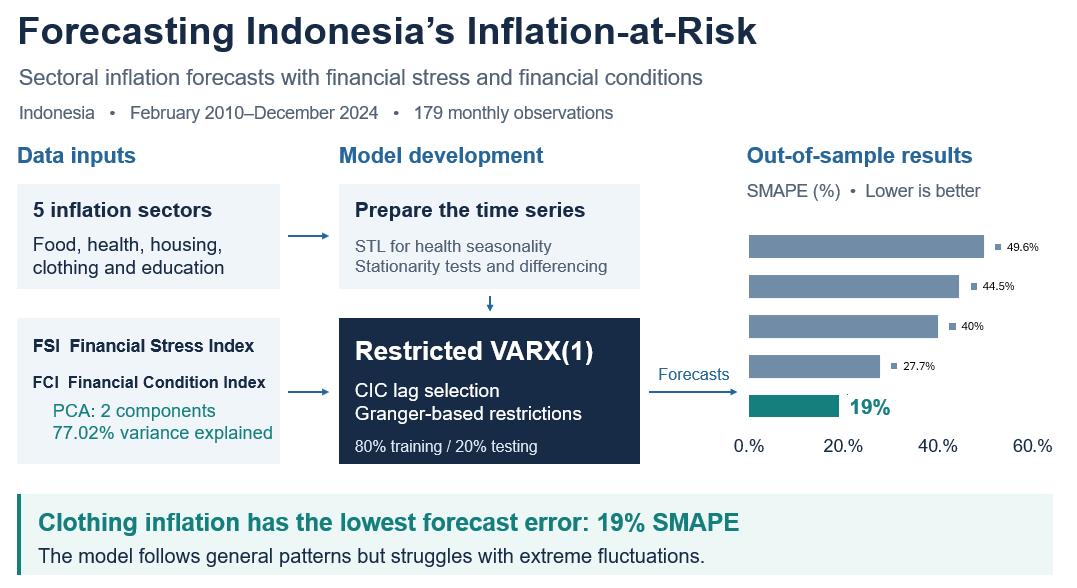
Inflation is a critical economic indicator influencing stability and monetary policy, making accurate forecasting essential. This study employs the Vector Autoregression with Exogenous Variables (VARX) model to simultaneously forecast Indonesia's inflation across various sectors, including food, health, housing, clothing, and education, incorporating the Financial Condition Index (FCI) and Financial Stress Index (FSI). The FSI evaluates financial stress using data from banking, foreign exchange, stock markets, and government securities, while the FCI assesses economic conditions through Principal Component Analysis (PCA). VARX is rarely used in this context and differs from previous studies in that it focuses on the risk of extreme inflation. In addition, this study introduces the use of the Correlation Information Criterion (CIC) as an evaluation tool, which has not been widely applied in similar research. The fluctuation patterns of each sectoral inflation generally display distinct characteristics, enabling a comprehensive evaluation of the VARX model’s ability to forecast data with varying fluctuation patterns. This approach differs from previous studies, which typically utilize data with uniform fluctuation patterns. Furthermore, the Seasonal Trend Decomposition Based on Loess (STL) method is employed to mitigate seasonal effects in the data and improve forecasting accuracy. This technique is rarely applied in this context. Analyzing monthly data from February 2010 to December 2024, the VARX(1) model effectively forecasts Indonesia's Inflation-at-Risk (IaR) with high accuracy, as measured using the Symmetric Mean Absolute Percentage Error (SMAPE) criterion. Seasonal inflation in the health sector is addressed using the Seasonal Trend Decomposition Based on Loess (STL) method, which further improves forecasting precision. However, the model struggles with extreme fluctuations, highlighting the need for future research into more advanced predictive models for volatile economic conditions.
References
Akbar, M. S., Setiawan, S., Suhartono, S., Ruchjana, B. N., Prastyo, D. D., Muhaimin, A., & Setyowati, E. (2020). A Generalized Space-Time Autoregressive Moving Average (GSTARMA) Model for Forecasting Air Pollutant in Surabaya. J. Phys.: Conf. Ser. 1490 (012022).
Chicco, D., Warrens, M. J., & Jurman, G. (2021). The coefficient of determination R-squared is more informative than SMAPE, MAE, MAPE, MSE and RMSE in regression analysis evaluation. PeerJ Computer Science, 18.
Cleveland, R. B., Cleveland, W. S., McRae, J. E., & Terpenning, I. (1990). STL: A Seasonal-Trend Decomposition Procedure Based on Loess. Journal of Official Statistics, 6(1), 3-73.
Farih, I., & Prastyo, D. D. (2022). Forecasting Electricity Consumption Based on Economics and Social Indicators Using VAR Model with Exogenous Variable: Evidence From East Java Province. in 022 6th International Conference on Information Technology, Information Systems and Electrical Engineering (ICITISEE). Yogyakarta.
Ferrara, L., Mogliani, M., & Sahuc, J.-G. (2022). High-frequency monitoring of growth at risk. International Journal of Forecasting, 38, 582-595.
Gujarati, D. N. (2003). Basic Econometrics. New York: Gary Burke.
Hikmawati, F., Suhartono, S., & Prastyo, D. D. (2021). A Hybrid GSTARX-Jordan RNN Model for Forecasting Space-Time Data with Calendar Variation Effect. J. Phys.: Conf. Ser. 1752 (012013).
Juhro, S. M., & Iyke, B. N. (2019). Monetary Policy and Financial Condition in Indonesia. Bulletin of Monetary Economics and Banking, 21, 283-302.
Novianto, M. A., Suhartono, S., Prastyo, D. D., Suharsono, A., & Setiawan, S. (2018). GSTARIX Model for Forecasting Spatio-Temporal Data with Trend, Seasonal and Intervention. J. Phys.: Conf. Ser. 1097 (012076).
Ocampo, S., & Rodríguez, N. (2012). An Introductory Review of a Structural VAR-X Estimation and Applications. Revista Colombiana de Estadística, 35, 479-508.
Park, C.-Y., & Mercado, R. V. (2014). Determinants of financial stress in emerging market economies. Journal of Banking & Finance, 45, 199-224.
Prastyo, D. D., Nabila, F. S., Suhartono, S., Lee, M. H., & Suhermi, N. F.-F. (2018). VAR and GSTAR-Based Feature Selection in Support Vector Regression for Multivariate Spatio-Temporal Forecasting. In Soft Computing in Data Science (SCDS), Communications in Computer and Information Science, vol 937. Springer.
Safuan, S., Sugandi, E. A., Aziz, O. Q., & Triandhari, R. (2022). Indonesia's Financial Stress Events and Macroeconomic Dynamics. Bulletin of Monetary Economics and Banking, 25, 323-370.
Sesay, A., Suhartono, S., & Prastyo, D. D. (2020). Forecasting Exchange Rate Across Countries with Gold Price as Exogenous Variable Using Transfer Function and VARI-X Model. MATEMATIKA, 36(3), 181-196.
Suhartono, S., Gazali, M. M., & Prastyo, D. D. (2018). VARX and GSTARX Models for Forecasting Currency Inflow and Outflow with Multiple Calendar Variations Effect. MATEMATIKA, 34(3), 57–72.
Suhartono, S., Prastyo, D. D., Kuswanto, H., & Lee, M. H. (2018). Comparison between VAR, GSTAR, FFNN-VAR and FFNN-GSTAR Models for Forecasting Oil Production. MATEMATIKA, 34(1), 103–111.
Tsay, R. S. (2002). Analysis of Financial Time Series. Canada: John Wiley & Sons, Inc.
Zivot, E., & Wang, J. (2003). Modeling Financial Time Series with S-Plus. New York: Springer Science+Bu siness Media.
Downloads
Published
Issue
Section
License
Copyright (c) 2026 Malaysian Journal of Science (MJS)

This work is licensed under a Creative Commons Attribution-NonCommercial 4.0 International License.
Transfer of Copyrights
- In the event of publication of the manuscript entitled [INSERT MANUSCRIPT TITLE AND REF NO.] in the Malaysian Journal of Science, I hereby transfer copyrights of the manuscript title, abstract and contents to the Malaysian Journal of Science and the Faculty of Science, University of Malaya (as the publisher) for the full legal term of copyright and any renewals thereof throughout the world in any format, and any media for communication.
Conditions of Publication
- I hereby state that this manuscript to be published is an original work, unpublished in any form prior and I have obtained the necessary permission for the reproduction (or am the owner) of any images, illustrations, tables, charts, figures, maps, photographs and other visual materials of whom the copyrights is owned by a third party.
- This manuscript contains no statements that are contradictory to the relevant local and international laws or that infringes on the rights of others.
- I agree to indemnify the Malaysian Journal of Science and the Faculty of Science, University of Malaya (as the publisher) in the event of any claims that arise in regards to the above conditions and assume full liability on the published manuscript.
Reviewer’s Responsibilities
- Reviewers must treat the manuscripts received for reviewing process as confidential. It must not be shown or discussed with others without the authorization from the editor of MJS.
- Reviewers assigned must not have conflicts of interest with respect to the original work, the authors of the article or the research funding.
- Reviewers should judge or evaluate the manuscripts objective as possible. The feedback from the reviewers should be express clearly with supporting arguments.
- If the assigned reviewer considers themselves not able to complete the review of the manuscript, they must communicate with the editor, so that the manuscript could be sent to another suitable reviewer.
Copyright: Rights of the Author(s)
- Effective 2007, it will become the policy of the Malaysian Journal of Science (published by the Faculty of Science, University of Malaya) to obtain copyrights of all manuscripts published. This is to facilitate:
- Protection against copyright infringement of the manuscript through copyright breaches or piracy.
- Timely handling of reproduction requests from authorized third parties that are addressed directly to the Faculty of Science, University of Malaya.
- As the author, you may publish the fore-mentioned manuscript, whole or any part thereof, provided acknowledgement regarding copyright notice and reference to first publication in the Malaysian Journal of Science and Faculty of Science, University of Malaya (as the publishers) are given. You may produce copies of your manuscript, whole or any part thereof, for teaching purposes or to be provided, on individual basis, to fellow researchers.
- You may include the fore-mentioned manuscript, whole or any part thereof, electronically on a secure network at your affiliated institution, provided acknowledgement regarding copyright notice and reference to first publication in the Malaysian Journal of Science and Faculty of Science, University of Malaya (as the publishers) are given.
- You may include the fore-mentioned manuscript, whole or any part thereof, on the World Wide Web, provided acknowledgement regarding copyright notice and reference to first publication in the Malaysian Journal of Science and Faculty of Science, University of Malaya (as the publishers) are given.
- In the event that your manuscript, whole or any part thereof, has been requested to be reproduced, for any purpose or in any form approved by the Malaysian Journal of Science and Faculty of Science, University of Malaya (as the publishers), you will be informed. It is requested that any changes to your contact details (especially e-mail addresses) are made known.
Copyright: Role and responsibility of the Author(s)
- In the event of the manuscript to be published in the Malaysian Journal of Science contains materials copyrighted to others prior, it is the responsibility of current author(s) to obtain written permission from the copyright owner or owners.
- This written permission should be submitted with the proof-copy of the manuscript to be published in the Malaysian Journal of Science
Licensing Policy
Malaysian Journal of Science is an open-access journal that follows the Creative Commons Attribution-Non-commercial 4.0 International License (CC BY-NC 4.0)
CC BY – NC 4.0: Under this licence, the reusers to distribute, remix, alter, and build upon the content in any media or format for non-commercial purposes only, as long as proper acknowledgement is given to the authors of the original work. Please take the time to read the whole licence agreement (https://creativecommons.org/licenses/by-nc/4.0/legalcode ).