Analysis of Relation Between Indicators in the Sustainable Development Goals in Indonesia Using Higher-Order PLS-PM
DOI:
https://doi.org/10.22452/mjs.vol45sp2.12Keywords:
SDGs, Higher-Order PLS-PM, indicator analysis, disaggregated dataAbstract
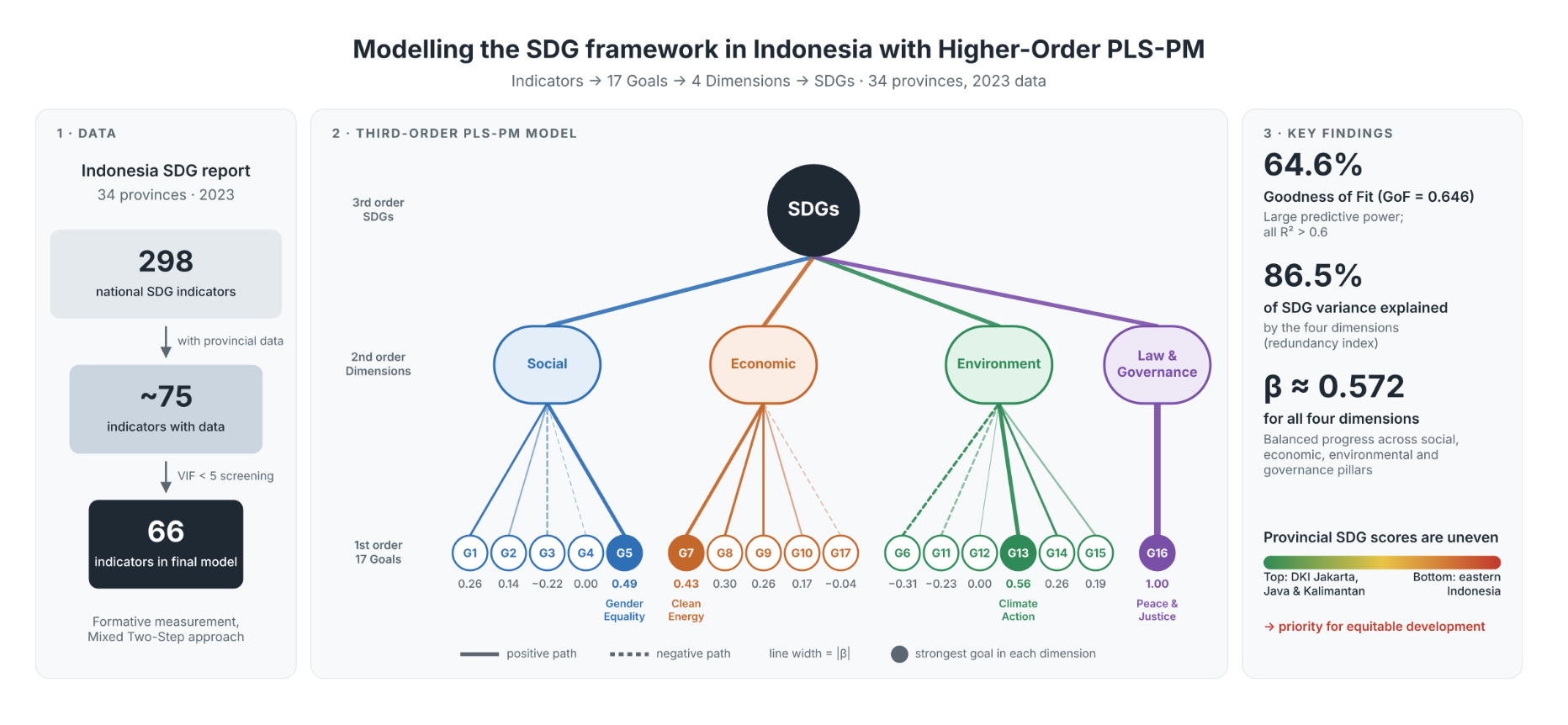
The world has been placing greater emphasis on the Sustainable Development Goals (SDGs) over the last decade, including in Indonesia. The SDGs represent a global commitment to enhancing community welfare and are structured around four dimensions: social, economic, environmental, and law and governance. The SDGs include 17 goals and some indicators for their measurement. Indonesia has achieved 62% of the 138 indicators targeted in 2022. The purpose of this research is to model the relationships among the dimensions, goals, and indicators of the SDGs, enabling an analysis of the main factors influencing sustainable development in Indonesia. Higher-Order Partial Least Square Path Modelling (PLS-PM) was used in this research to map the relationship between each dimension, goal, and indicator. The indicators were derived from the annual SDG report as the data from 34 provinces in 2023. The results of the 298 indicators are reduced to 75 indicators that exist its data on provincial level. Goal 3 “Good Health and Well-Being” is giving the most influence in social dimension of SDGs, while for the economic dimension and environment dimension are Goal 8 “Decent Work and Economic Growth” and Goal 13 “Climate Action”. The validation of the model shows that its predictive power is 64.55%, indicating that the constructed model closely fits the data. The findings of this study may be the consideration for policymakers in planning sustainable development in Indonesia to achieve the SDGs by 2030.
References
Alisjahbana, A.S., Murniningtyas, E. (2020) Tujuan Pembangunan Berkelanjutan (SDGs) di Indonesia. Unpad Press. Available online, accessed December 27, 2024.
Bappenas (2023) Laporan Pelaksanaan Pencapaian Tujuan Pembangunan Berkelanjutan (TPB/SDGs) Tahun 2023. Available online, accessed January 9, 2025.
Bihun, R., Lytvyn, V., Oleksiv, N. (2022) Mathematical modeling of tourism development in terri torial communities, Technol. Audit Prod. Reserves 2(2/64): 21–30.
Boubker, O., Douayri, K. (2020) Dataset on the relationship between consumer satisfaction, brand attitude, brand preference and purchase intentions of dairy product: The case of the Laayoune Sakia El Hamra region in Morocco, DataBrief. 32, 106172.
BPS (2024) Indonesian Sustainable Development Goals Indicators 2024. Available online, accessed January 22, 2025.
Cataldo, R., Corbisiero, F., Delle Cave, L., Grassia, M.G., Marino, M., Zavarrone, E. (2019) The Quality of Life in the Historic Centre of Naples: the use of PLS-PM Models to measure the Well-Being of the Citizens of Naples, Ital. Stud. Qual. Life, 111–125.
Cataldo, R., Crocetta, C., Grassia, M.G., Lauro, N.C., Marino, M., Voytsekhovska, V. (2021) Methodological PLS-PM framework for SDGs system, Soc. Indic. Res. 156, 701–723.
Cataldo, R., Cascella, C., Grassia, M.G., Lauro, C.N., Voytsekhovska, V. (2024) A PLS Hierarchical Path Modeling approach to analyze and address gender equality in the EU countries, Socio-Econ. Plan. Sci. 96, 102076.
Crocetta, C., Antonucci, L., Cataldo, R., Galasso, R., Grassia, M.G., Lauro, C.N., Marino, M. (2021) Higher-order PLS-PM approach for different types of constructs, Soc. Indic. Res. 154, 725–754.
de Morais Fernandes, G.H., do Valle Junior, R.F., de Melo Silva, M.M.A.P., Mendes, R.G., Fernandes, L.F.S., Fernandes, A.C.P., Pacheco, F.A.L., Pissarra, T.C.T., de Melo, M.C., Valera, C.A. (2023) A structural equation model of land capability and related drivers: Implications for land degradation forecasting in a tropical river basin, Land Degradation & Development 34(6): 1778–1794.
Henseler, J., Sarstedt, M. (2013) Goodness-of-fit indices for partial least squares path modeling, Comput. Stat. 28, 565–580.
Maia, R.V.D.L., Brigido, W.J.H., De Oliveira, J.M.P. (2024) Influencing factors on internal auditing maturity using PLS-PM, IEEE Access.
Pu, X., Cheng, Q. (2024) Unraveling the impacts of multiscale landscape patterns and socioeco nomic development on water quality: A case study of the National Sustainable Development Agenda Innovation Demonstration Zone in Lincang City, Southwest China, J. Hydrol. Reg. Stud. 51, 101660.
Rajani F., Boluk K.A. (2022) A critical commentary on the SDGs and the role of tourism, Tourism and Hospitality 3 (4): 855-860.
Sanchez, G. (2013) PLS Path Modeling with R, Trowchez Editions.
Sun, H., Shi, Y., Li, C., He, S., Bai, Y., Zhao, P., Qiu, D., Liu, J., He, S. (2024) Factors control ling the heavy metal ion activity in soil contaminated by microplastics with different mulch durations: Partial least squares path model, J. Hazard. Mater. 464, 133027.
Yang, Z., Liu, V., Lyu, C. (2024) Exploring social sharing value: Effects on customer attitudes and behaviors in restaurant livestreaming, Behavioral Sciences 14(7), 621.
Zafeer, H.M.I., Maqbool, S., Rong, Y., Maqbool, S. (2024) Mapping the relationship and influence of school internal factors with an eye towards students’ science academic outcomes, Heliyon 10(19).
Downloads
Published
Issue
Section
License
Copyright (c) 2026 Malaysian Journal of Science (MJS)

This work is licensed under a Creative Commons Attribution-NonCommercial 4.0 International License.
Transfer of Copyrights
- In the event of publication of the manuscript entitled [INSERT MANUSCRIPT TITLE AND REF NO.] in the Malaysian Journal of Science, I hereby transfer copyrights of the manuscript title, abstract and contents to the Malaysian Journal of Science and the Faculty of Science, University of Malaya (as the publisher) for the full legal term of copyright and any renewals thereof throughout the world in any format, and any media for communication.
Conditions of Publication
- I hereby state that this manuscript to be published is an original work, unpublished in any form prior and I have obtained the necessary permission for the reproduction (or am the owner) of any images, illustrations, tables, charts, figures, maps, photographs and other visual materials of whom the copyrights is owned by a third party.
- This manuscript contains no statements that are contradictory to the relevant local and international laws or that infringes on the rights of others.
- I agree to indemnify the Malaysian Journal of Science and the Faculty of Science, University of Malaya (as the publisher) in the event of any claims that arise in regards to the above conditions and assume full liability on the published manuscript.
Reviewer’s Responsibilities
- Reviewers must treat the manuscripts received for reviewing process as confidential. It must not be shown or discussed with others without the authorization from the editor of MJS.
- Reviewers assigned must not have conflicts of interest with respect to the original work, the authors of the article or the research funding.
- Reviewers should judge or evaluate the manuscripts objective as possible. The feedback from the reviewers should be express clearly with supporting arguments.
- If the assigned reviewer considers themselves not able to complete the review of the manuscript, they must communicate with the editor, so that the manuscript could be sent to another suitable reviewer.
Copyright: Rights of the Author(s)
- Effective 2007, it will become the policy of the Malaysian Journal of Science (published by the Faculty of Science, University of Malaya) to obtain copyrights of all manuscripts published. This is to facilitate:
- Protection against copyright infringement of the manuscript through copyright breaches or piracy.
- Timely handling of reproduction requests from authorized third parties that are addressed directly to the Faculty of Science, University of Malaya.
- As the author, you may publish the fore-mentioned manuscript, whole or any part thereof, provided acknowledgement regarding copyright notice and reference to first publication in the Malaysian Journal of Science and Faculty of Science, University of Malaya (as the publishers) are given. You may produce copies of your manuscript, whole or any part thereof, for teaching purposes or to be provided, on individual basis, to fellow researchers.
- You may include the fore-mentioned manuscript, whole or any part thereof, electronically on a secure network at your affiliated institution, provided acknowledgement regarding copyright notice and reference to first publication in the Malaysian Journal of Science and Faculty of Science, University of Malaya (as the publishers) are given.
- You may include the fore-mentioned manuscript, whole or any part thereof, on the World Wide Web, provided acknowledgement regarding copyright notice and reference to first publication in the Malaysian Journal of Science and Faculty of Science, University of Malaya (as the publishers) are given.
- In the event that your manuscript, whole or any part thereof, has been requested to be reproduced, for any purpose or in any form approved by the Malaysian Journal of Science and Faculty of Science, University of Malaya (as the publishers), you will be informed. It is requested that any changes to your contact details (especially e-mail addresses) are made known.
Copyright: Role and responsibility of the Author(s)
- In the event of the manuscript to be published in the Malaysian Journal of Science contains materials copyrighted to others prior, it is the responsibility of current author(s) to obtain written permission from the copyright owner or owners.
- This written permission should be submitted with the proof-copy of the manuscript to be published in the Malaysian Journal of Science
Licensing Policy
Malaysian Journal of Science is an open-access journal that follows the Creative Commons Attribution-Non-commercial 4.0 International License (CC BY-NC 4.0)
CC BY – NC 4.0: Under this licence, the reusers to distribute, remix, alter, and build upon the content in any media or format for non-commercial purposes only, as long as proper acknowledgement is given to the authors of the original work. Please take the time to read the whole licence agreement (https://creativecommons.org/licenses/by-nc/4.0/legalcode ).