Simulation Study of Agglomerative Clustering Algorithms for Detecting Outliers in Univariate Circular Data
DOI:
https://doi.org/10.22452/mjs.vol45sp2.9Keywords:
Circular data, Agglomerative clustering algorithms, Outlier detection, Outlier scenario, Simulation studyAbstract
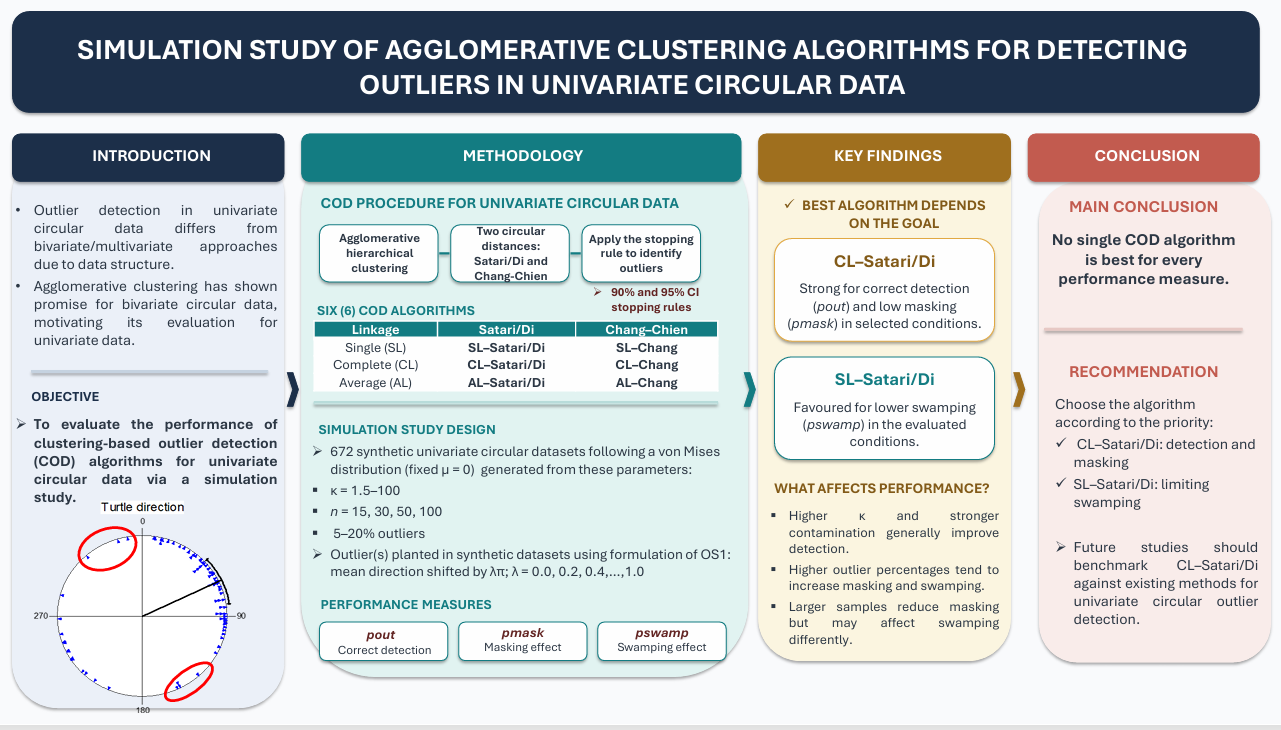
Outlier detection techniques for univariate circular data are distinct from those designed for bivariate or multivariate contexts due to differences in data structure and dimensionality. In earlier research, clustering-based procedures specifically those utilizing agglomerative algorithms have proven effective for detecting outliers in bivariate circular datasets. This study aims to evaluate the performance of agglomerative clustering algorithms such as single-linkage (SL), complete-linkage (CL) and average-linkage (AL) by conducting a simulation study for a clustering-based outlier detection (COD) procedure for univariate circular data. The performance of the clustering algorithms from COD procedure assessed across various simulated data conditions under a specific outlier scenario. In the simulation study, outliers are embedded within synthetic datasets using a defined outlier scenario, where the mean direction is shifted by varying degrees of contamination to distinguish outliers from inliers. The simulation study revealed that CL-Satari/Di algorithm has the best performance on detecting outliers correctly with minimal masking effect under specific data conditions. Meanwhile, the performance of SL-Satari/Di algorithm found to be the best algorithm with low swamping effect even though not performing well in detecting correct outliers. This result also revealed that the concentration parameter, percentage of outliers, and sample size affect the performance of the clustering algorithms. The findings demonstrate that the algorithms effectively detect outliers with low masking and swamping effects when the concentration parameter is large. The simulation results also found that the algorithms performed well in detecting outliers when percentage of outliers is small with low masking effect but producing high swamping effect. Moreover, large sample size was found to be less sensitive to masking effect, while a smaller sample size is less sensitive to swamping effect. This work extends existing research on identifying outliers within univariate circular datasets by employing a clustering-based procedure as its core framework.
References
Abuzaid, A. H. (2020). Detection of outliers in univariate circular data by means of the outlier local factor (LOF). Statistics in Transition New Series, 21(3), 39–51.
Abuzaid, A. H., Hussin, A. G., Rambli, A., & Mohamed, I. (2012). Statistics for a new test of discordance in circular data. Communications in Statistics—Simulation and Computation, 41, 1882–1890.
Abuzaid, A. H., Mohamed, I. B., & Hussin, A. G. (2009). A new test of discordancy in circular data. Communications in Statistics - Simulation and Computation, 38(4), 682–691.
Collett, D. (1980). Outliers in circular data. Journal of the Royal Statistical Society: Series C (Applied Statistics), 29(1), 50–57.
Di, N. F. M., & Satari, S. Z. (2017). The effect of different distance measures in detecting outliers using clustering-based algorithm for circular regression model. AIP Conference Proceedings, 1842, 030016. https://doi.org/10.1063/1.4982059
Di, N. F. M., Satari, S. Z., & Zakaria, R. (2017). Detection of different outlier scenarios in circular regression model using single-linkage method. Journal of Physics: Conference Series, 890(1). https://doi.org/10.1088/1742-6596/890/1/012088.
El, H.I., Ahmed, S., Abuzaid, A.H., & Awar, I.I. (2019). Detection of Outliers in Circular Data using Kernel Density Function. Life Sciences: An International Journal (LSIJ), 1(1), 1–11.
Hung, W. L., Chang-Chien, S. J., & Yang, M. S. (2012). Self-updating clustering algorithm for estimating the parameters in mixtures of von Mises distributions. Journal of Applied Statistics, 39(10), 2259–2274.
Johnson, R., & Wichern, D. (2014). Applied multivariate statistical analysis (6th ed.). Pearson.
Mahmood, E. A., Rana, S., Hussin, A. G., & Midi, H. (2017a). Adjusting outliers in univariate circular data. Pertanika Journal of Science & Technology, 25(4), 1147–1158
Mahmood, E. A., Rana, S., Midi, H., & Hussin, A. G. (2017b). Detection of outliers in univariate circular data using robust circular distance. Journal of Modern Applied Statistical Methods, 16(2), 418–438.
Rambli, A., Ibrahim, S., & Mohamed, I. (2012). On discordance test for the wrapped normal data. Sains Malaysiana, 41(6), 769–778.
Ramlee, I. M., Ibrahim, S., Zhe, L. W., & Yusoff, M. I. (2024). Detection of Outliers in Circular Regression Model via DFBETAcIS Statistic. Sains Malaysiana, 53(4), 935–951.
Rattanawong, B., Papukdee, N., & Srisodaphol, W. (2023). Detection of Outliers in Univariate Circular Data Using New Cut-off Points for the Circular Distance. Philippine Journal of Science, 152(5), 2019–2026.
Satari, S. Z. (2015). Parameter estimation and outlier detection for some types of circular model (Doctoral dissertation, University of Malaya).
Satari, S. Z., & Ku Khalif, K. M. N. (2020). Review on outliers identification methods for univariate circular biological data. Advances in Science, Technology and Engineering Systems, 5(2), 95–103.
Satari, S. Z., Muhammad Di, N. F., Zubairi, Y. Z., & Hussin, A. G. (2021). Comparative study of clustering-based outliers detection methods in circular-circular regression model. Sains Malaysiana, 50(6), 1787–1798.
Sebert, D. M., Montgomery, D. C., & Rollier, D. A. (1998). A clustering algorithm for identifying multiple outliers in linear regression. Computational Statistics and Data Analysis, 27, 461–484.
Sert, S., & Kardiyen, F. (2023). A method for detecting outliers in linear-circular non-parametric regression. PLoS ONE, 18(6 June), 1–17.
Zulkipli, N. S., Satari, S. Z., & Wan Yusoff, W. N. S. (2022). The effect of different similarity distance measures in detecting outliers using single-linkage clustering algorithm for univariate circular biological data. Pakistan Journal of Statistics and Operation Research, 18(3), 561–573.
Zulkipli, N. S., Satari, S. Z., & Wan Yusoff, W. N. S. (2024a). The Multiple Outliers Detection for Circular Univariate Data Using Different Agglomerative Clustering Algorithms. AIP Conference Proceedings, 2895(1): p. 090007.
Zulkipli, N. S., Satari, S. Z., & Wan Yusoff, W. N. S. (2024b). Abnormalities detection in Apert syndrome using hierarchical clustering algorithms. Journal of Advanced Research in Applied Sciences and Engineering Technology, 44(4), 135–174.
Downloads
Published
Issue
Section
License
Copyright (c) 2026 Malaysian Journal of Science (MJS)

This work is licensed under a Creative Commons Attribution-NonCommercial 4.0 International License.
Transfer of Copyrights
- In the event of publication of the manuscript entitled [INSERT MANUSCRIPT TITLE AND REF NO.] in the Malaysian Journal of Science, I hereby transfer copyrights of the manuscript title, abstract and contents to the Malaysian Journal of Science and the Faculty of Science, University of Malaya (as the publisher) for the full legal term of copyright and any renewals thereof throughout the world in any format, and any media for communication.
Conditions of Publication
- I hereby state that this manuscript to be published is an original work, unpublished in any form prior and I have obtained the necessary permission for the reproduction (or am the owner) of any images, illustrations, tables, charts, figures, maps, photographs and other visual materials of whom the copyrights is owned by a third party.
- This manuscript contains no statements that are contradictory to the relevant local and international laws or that infringes on the rights of others.
- I agree to indemnify the Malaysian Journal of Science and the Faculty of Science, University of Malaya (as the publisher) in the event of any claims that arise in regards to the above conditions and assume full liability on the published manuscript.
Reviewer’s Responsibilities
- Reviewers must treat the manuscripts received for reviewing process as confidential. It must not be shown or discussed with others without the authorization from the editor of MJS.
- Reviewers assigned must not have conflicts of interest with respect to the original work, the authors of the article or the research funding.
- Reviewers should judge or evaluate the manuscripts objective as possible. The feedback from the reviewers should be express clearly with supporting arguments.
- If the assigned reviewer considers themselves not able to complete the review of the manuscript, they must communicate with the editor, so that the manuscript could be sent to another suitable reviewer.
Copyright: Rights of the Author(s)
- Effective 2007, it will become the policy of the Malaysian Journal of Science (published by the Faculty of Science, University of Malaya) to obtain copyrights of all manuscripts published. This is to facilitate:
- Protection against copyright infringement of the manuscript through copyright breaches or piracy.
- Timely handling of reproduction requests from authorized third parties that are addressed directly to the Faculty of Science, University of Malaya.
- As the author, you may publish the fore-mentioned manuscript, whole or any part thereof, provided acknowledgement regarding copyright notice and reference to first publication in the Malaysian Journal of Science and Faculty of Science, University of Malaya (as the publishers) are given. You may produce copies of your manuscript, whole or any part thereof, for teaching purposes or to be provided, on individual basis, to fellow researchers.
- You may include the fore-mentioned manuscript, whole or any part thereof, electronically on a secure network at your affiliated institution, provided acknowledgement regarding copyright notice and reference to first publication in the Malaysian Journal of Science and Faculty of Science, University of Malaya (as the publishers) are given.
- You may include the fore-mentioned manuscript, whole or any part thereof, on the World Wide Web, provided acknowledgement regarding copyright notice and reference to first publication in the Malaysian Journal of Science and Faculty of Science, University of Malaya (as the publishers) are given.
- In the event that your manuscript, whole or any part thereof, has been requested to be reproduced, for any purpose or in any form approved by the Malaysian Journal of Science and Faculty of Science, University of Malaya (as the publishers), you will be informed. It is requested that any changes to your contact details (especially e-mail addresses) are made known.
Copyright: Role and responsibility of the Author(s)
- In the event of the manuscript to be published in the Malaysian Journal of Science contains materials copyrighted to others prior, it is the responsibility of current author(s) to obtain written permission from the copyright owner or owners.
- This written permission should be submitted with the proof-copy of the manuscript to be published in the Malaysian Journal of Science
Licensing Policy
Malaysian Journal of Science is an open-access journal that follows the Creative Commons Attribution-Non-commercial 4.0 International License (CC BY-NC 4.0)
CC BY – NC 4.0: Under this licence, the reusers to distribute, remix, alter, and build upon the content in any media or format for non-commercial purposes only, as long as proper acknowledgement is given to the authors of the original work. Please take the time to read the whole licence agreement (https://creativecommons.org/licenses/by-nc/4.0/legalcode ).