Deterministic and Stochastic Gompertz Prey-Predator Model for the Effect of Thymoquinone on Oral Squamous Carcinoma Cell Lines (HSC-4)
DOI:
https://doi.org/10.22452/mjs.vol45sp2.7Keywords:
Deterministic model, stochastic model, thymoquinone, oral cancerAbstract
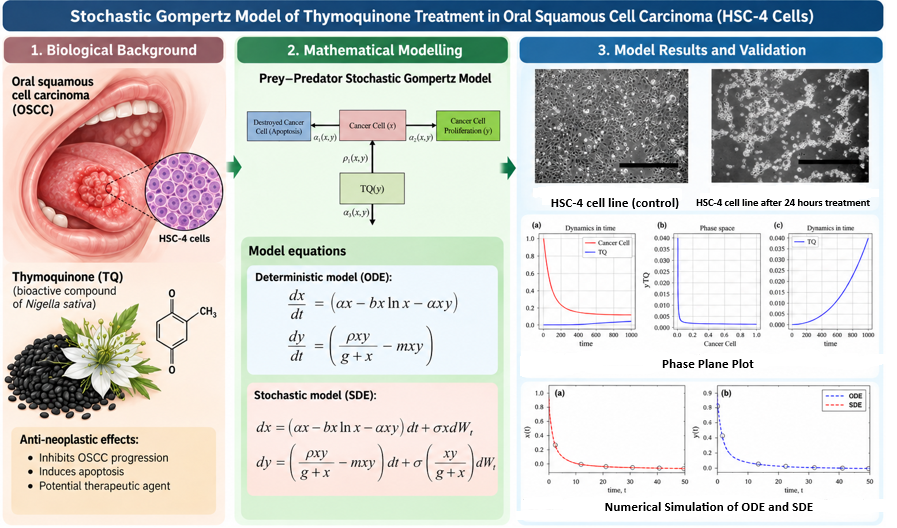
Oral squamous cell carcinoma (OSCC) is one of the most common malignancies affecting the head and neck region. Thymoquinone (TQ), the primary bioactive compound of black seed (Nigella sativa), has shown antineoplastic properties in various tumor cell types. However, research on TQ effects in tumor cell models, particularly OSCC, remains at an early stage. TQ, a phytochemical with confirmed anticancer potential, has been shown to inhibit OSCC progression mainly through induction of apoptosis. In this study, a prey–predator stochastic Gompertz model is used to characterize the dynamics of the HSC-4 OSCC cell line in response to TQ treatment. The model is first formulated as an ordinary differential equation (ODE), then extended to a stochastic differential equation (SDE) to capture biological noise arising from intrinsic and extrinsic sources within the cellular environment. The Markov Chain Monte Carlo (MCMC) method is utilized to estimate the model’s kinetic parameters, while fourth-order stochastic Runge-Kutta (SRK4) algorithms are applied for numerical simulation. Model outputs are validated against in vitro experimental data from TQ-treated HSC-4 cells. The deterministic framework is analyzed in terms of the positivity of solutions and equilibrium states, including the disease-free equilibrium (DFE), the treatment-failure equilibrium (TFE), and the successful treatment equilibrium (SFE). The root mean-square error (RMSE) is computed to assess the consistency between simulated outcomes and experimental observations. The findings demonstrate the model's capability in capturing and explaining the dynamic behavior of HSC-4 cells under TQ treatment.
References
Abu Khader, M. M. (2013). Thymoquinone in the clinical treatment of cancer: Fact or fiction? Pharmacognosy Reviews, 7(14), 117.
Alaufi, O. M., Noorwali, A., Zahran, F., Al-Abd, A. M., Al-Attas, S. (2017). Cytotoxicity of thymoquinone alone or in combination with cisplatin (CDDP) against oral squamous cell carcinoma in vitro. Scientific Reports, 7: 13131.
Cadoni, G., Giraldi, L., Petrelli, L., Pandolfini, M., Giuliani, M., Paludetti, G., ..., Boccia, S. (2017). Prognostic factors in head and neck cancer: A 10-year retrospective analysis in a single institution in Italy. Acta Otorhinolaryngologica Italica, 37(6): 458–466.
Chen, P. N., Chu, S. C., Kuo, W. H., Chou, M. Y., Lin, J. K., & Hsieh, Y. S. (2011). Epigallocatechin-3 gallate inhibits invasion, epithelial−mesenchymal transition, and tumor growth in oral cancer cells. Journal of Agricultural and Food Chemistry, 59 (8):3836–3844.
Emanuel, E. J., Emanuel, L. L. (1992). Four models of the physician-patient relationship. JAMA, 267(16): 2221–2226.
Gali-Muhtasib, H., Roessner, A., Schneider-Stock, R. (2006). Thymoquinone: A promising anti-cancer drug from natural sources. The International Journal of Biochemistry & Cell Biology, 38(8): 1249–1253.
Global Cancer Observatory. (2025). International Agency for Research on Cancer. https://gco.iarc.who.int (accessed May 16, 2025)
González-Moles, M. Á., Aguilar-Ruiz, M., & Ramos-García, P. (2022). Challenges in the early diagnosis of oral cancer, evidence gaps and strategies for improvement: A scoping review of systematic reviews. Cancers, 14(19): 4967.
Hannan, M. A., Rahman, M. A., Sohag, A. A. M., Uddin, M. J., Dash, R., Sikder, M. H., ... Kim, B. (2021). Black cumin (Nigella sativa L.): A comprehensive review on phytochemistry, health benefits, molecular pharmacology, and safety. Nutrients, 13(6): 1784.
Hu, G., Li, B., Geng, Z. (2024). Analysis of a stochastic hybrid Gompertz tumor growth model driven by Lévy noise. Stochastic Models, 1–22.
Jallah, J. K., Dweh, T. J., Anjankar, A., & Palma, O. (2023). A review of the advancements in targeted therapies for breast cancer. Cureus, 15(10).
Kasteb, F. H., Saileau, K., & Meffert, R. M. (1990). Quantitative evaluation of human gingival epithelial cell attachment to implant surfaces in vitro. The International Journal of Periodontics & Restorative Dentistry, 10(1): 68–79.
Kazerouni, A. S., Gadde, M., Gardner, A., Hormuth, D. A., Jarrett, A. M., Johnson, K. E., ... & Yankeelov, T. E. (2020). Integrating quantitative assays with biologically based mathematical modeling for predictive oncology. iScience, 23(12).
Kuznetsov, V. A., Makalkin, I. A., Taylor, M. A., & Perelson, A. S. (1994). Nonlinear dynamics of immunogenic tumors: Parameter estimation and global bifurcation analysis. Bulletin of Mathematical Biology, 56(2): 295–321.
Lv, H., He, G., Cheng, H., & Peng, Y. (2022). Stochastic behaviors of an improved Gompertz tumor growth model with coupled two types of noise. Heliyon, 8(11).
Mazlan, M. S. A., Rosli, N., Ichwan, S. J. A., & Azmi, N. S. (2017). Modelling the cancer growth process by stochastic differential equations with the effect of chondroitin sulfate (CS) as anticancer therapeutics. Journal of Physics: Conference Series, 890(1): 012085.
National Cancer Institute. (2025). SEER Cancer Stat Facts: Oral Cavity and Pharynx Cancer. https://seer.cancer.gov/statfacts/html/oralcav.html (accessed, May 16, 2025)
Norton, L. (1988). A Gompertzian model of human breast cancer growth. Cancer Research, 48(24): 7067–7071.
Rana, S. M. S. (2020). Dynamic complexity in a discrete-time predator-prey system with Michaelis-Menten functional response: Gompertz growth of prey. Computational Ecology and Software, 10(3): 117.
Steliarova-Foucher, E., Colombet, M., Ries, L. A. G., et al. (2017). International incidence of childhood cancer, 2001–10: A population-based registry study. The Lancet Oncology, 18(6): 719–731.
Steliarova-Foucher, E., Stiller, C., Lacour, B., Kaatsch, P. (2005). International Classification of Childhood Cancer, third edition. Cancer, 103(7): 1457–1467.
Tabassum, S., Rosli, N., & Arief, S. J. I. (2024). Stochastic Gompertz model for the oral cancer cell line HSC-3 response to an anticancer thymoquinone. AIP Conference Proceedings 2895(1).
Tabassum, S., Thakur, V., Rosli, N., Ichwan, S. J. A., Mishra, P., & Suriyah, W. H. (2022). Therapeutic implications of thymoquinone and its molecular and functional mechanisms against oral and lung cancer. Gene Reports, 27, 101600.
Downloads
Published
Issue
Section
License
Copyright (c) 2026 Malaysian Journal of Science (MJS)

This work is licensed under a Creative Commons Attribution-NonCommercial 4.0 International License.
Transfer of Copyrights
- In the event of publication of the manuscript entitled [INSERT MANUSCRIPT TITLE AND REF NO.] in the Malaysian Journal of Science, I hereby transfer copyrights of the manuscript title, abstract and contents to the Malaysian Journal of Science and the Faculty of Science, University of Malaya (as the publisher) for the full legal term of copyright and any renewals thereof throughout the world in any format, and any media for communication.
Conditions of Publication
- I hereby state that this manuscript to be published is an original work, unpublished in any form prior and I have obtained the necessary permission for the reproduction (or am the owner) of any images, illustrations, tables, charts, figures, maps, photographs and other visual materials of whom the copyrights is owned by a third party.
- This manuscript contains no statements that are contradictory to the relevant local and international laws or that infringes on the rights of others.
- I agree to indemnify the Malaysian Journal of Science and the Faculty of Science, University of Malaya (as the publisher) in the event of any claims that arise in regards to the above conditions and assume full liability on the published manuscript.
Reviewer’s Responsibilities
- Reviewers must treat the manuscripts received for reviewing process as confidential. It must not be shown or discussed with others without the authorization from the editor of MJS.
- Reviewers assigned must not have conflicts of interest with respect to the original work, the authors of the article or the research funding.
- Reviewers should judge or evaluate the manuscripts objective as possible. The feedback from the reviewers should be express clearly with supporting arguments.
- If the assigned reviewer considers themselves not able to complete the review of the manuscript, they must communicate with the editor, so that the manuscript could be sent to another suitable reviewer.
Copyright: Rights of the Author(s)
- Effective 2007, it will become the policy of the Malaysian Journal of Science (published by the Faculty of Science, University of Malaya) to obtain copyrights of all manuscripts published. This is to facilitate:
- Protection against copyright infringement of the manuscript through copyright breaches or piracy.
- Timely handling of reproduction requests from authorized third parties that are addressed directly to the Faculty of Science, University of Malaya.
- As the author, you may publish the fore-mentioned manuscript, whole or any part thereof, provided acknowledgement regarding copyright notice and reference to first publication in the Malaysian Journal of Science and Faculty of Science, University of Malaya (as the publishers) are given. You may produce copies of your manuscript, whole or any part thereof, for teaching purposes or to be provided, on individual basis, to fellow researchers.
- You may include the fore-mentioned manuscript, whole or any part thereof, electronically on a secure network at your affiliated institution, provided acknowledgement regarding copyright notice and reference to first publication in the Malaysian Journal of Science and Faculty of Science, University of Malaya (as the publishers) are given.
- You may include the fore-mentioned manuscript, whole or any part thereof, on the World Wide Web, provided acknowledgement regarding copyright notice and reference to first publication in the Malaysian Journal of Science and Faculty of Science, University of Malaya (as the publishers) are given.
- In the event that your manuscript, whole or any part thereof, has been requested to be reproduced, for any purpose or in any form approved by the Malaysian Journal of Science and Faculty of Science, University of Malaya (as the publishers), you will be informed. It is requested that any changes to your contact details (especially e-mail addresses) are made known.
Copyright: Role and responsibility of the Author(s)
- In the event of the manuscript to be published in the Malaysian Journal of Science contains materials copyrighted to others prior, it is the responsibility of current author(s) to obtain written permission from the copyright owner or owners.
- This written permission should be submitted with the proof-copy of the manuscript to be published in the Malaysian Journal of Science
Licensing Policy
Malaysian Journal of Science is an open-access journal that follows the Creative Commons Attribution-Non-commercial 4.0 International License (CC BY-NC 4.0)
CC BY – NC 4.0: Under this licence, the reusers to distribute, remix, alter, and build upon the content in any media or format for non-commercial purposes only, as long as proper acknowledgement is given to the authors of the original work. Please take the time to read the whole licence agreement (https://creativecommons.org/licenses/by-nc/4.0/legalcode ).