Comparative Analysis of Time Series Models: LSTM, Arima, FB Prophet for Predicting Rainfall and Streamflow
DOI:
https://doi.org/10.22452/mjs.vol45sp2.6Keywords:
LSTM, ARIMA, Facebook Prophet, time series analysis, rainfall predictionAbstract
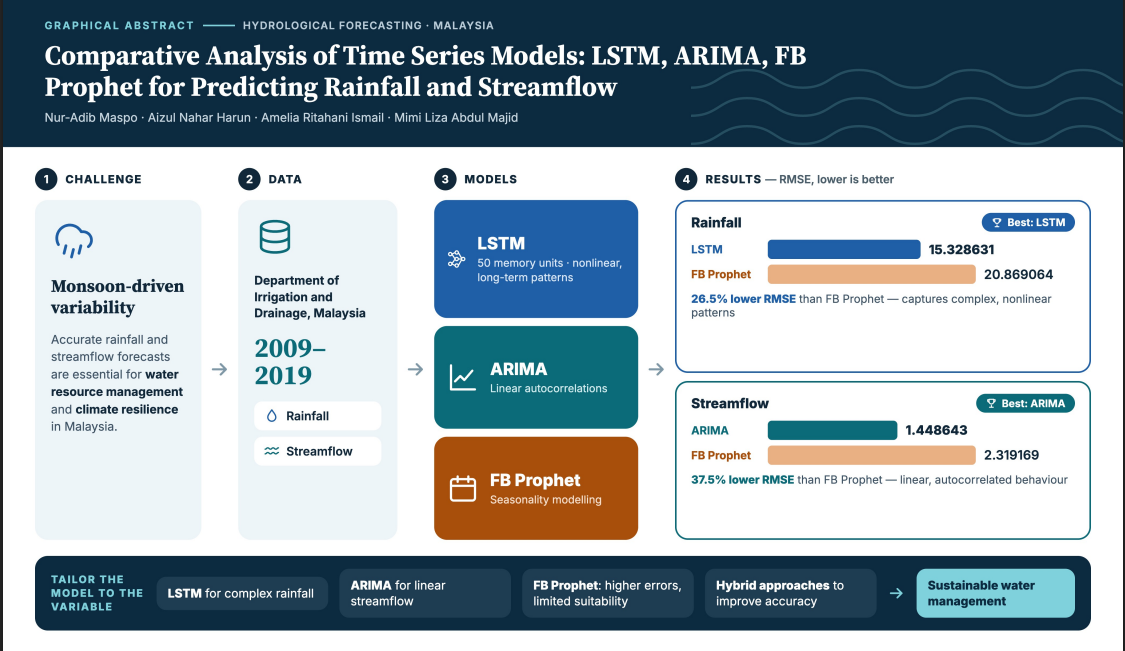
Accurate forecasting of rainfall and streamflow is essential for water resource management and climate resilience in Malaysia, particularly under monsoon-driven variability. This study evaluates Long Short-Term Memory (LSTM), Autoregressive Integrated Moving Average (ARIMA), and Facebook Prophet (FB Prophet) for predicting these hydrological variables using data from the Department of Irrigation and Drainage, Malaysia (2009–2019). LSTM, with its 50-memory-unit architecture, achieved the lowest Root Mean Square Error (RMSE) of 15.328631 for rainfall, excelling in capturing nonlinear, long-term patterns. ARIMA outperformed with an RMSE of 1.448643 for streamflow, using linear autocorrelations. FB Prophet showed higher errors: RMSE 20.869064 for rainfall, 2.319169 for streamflow, indicating limited suitability despite its seasonality modeling. The findings underscore the importance of tailoring model selection to hydrological variables: LSTM for complex rainfall, ARIMA for linear streamflow, while advocating hybrid approaches to improve accuracy. This research offers practical insights into the strengths of models, contributing to sustainable water management and addressing global water issues.
References
Abdullah, M. S., Selamat, A., Do, N. Q., Abu, M. A., Lim, K. C., & Krejcar, O. (2024, December). Rainfall Prediction based on Time-series Data and Temporal Convolutional Network for Flood Forecasting in Malaysia. In 2024 IEEE International Conference on Computing (ICOCO) (pp. 404-409). IEEE.
Adnan, R. M., Yuan, X., Kisi, O., & Curtef, V. (2017). Application of time series models for streamflow forecasting. Civil and Environmental Research, 9(3), 56-63.
Agaj, T., Budka, A., Janicka, E., & Bytyqi, V. (2024). Using ARIMA and ETS models for forecasting water level changes for sustainable environmental management. Scientific Reports, 14(1), 22444.
Aguilera, H., Guardiola-Albert, C., Naranjo-Fernández, N., & Kohfahl, C. (2019). Towards flexible groundwater-level prediction for adaptive water management: using Facebook’s Prophet forecasting approach. Hydrological Sciences Journal, 64(12), 1504-1518.
Bakhshi Ostadkalayeh, F., Moradi, S., Asadi, A., Moghaddam Nia, A., & Taheri, S. (2023). Performance improvement of LSTM-based deep learning model for streamflow forecasting using Kalman filtering. Water Resources Management, 37(8), 3111-3127.
Ghimire, S., Yaseen, Z. M., Farooque, A. A., Deo, R. C., Zhang, J., & Tao, X. (2021). Streamflow prediction using an integrated methodology based on convolutional neural network and long short-term memory networks. Scientific Reports, 11(1), 17497.
Hossain, M. M., Anwar, A. F., Garg, N., Prakash, M., & Bari, M. (2022). Monthly rainfall prediction at catchment level with the Facebook Prophet model using observed and CMIP5 decadal data. Hydrology, 9(6), 111.
Ibrahim, N., Ahmad, N., Jan, N.A.M., Zainudin, Z., Jamil, N.S. and Azlan, A., 2024, September. Comparative Analysis of ARIMA and LSTM Approaches for Monthly River Flow Forecasting in Terengganu. In 2024 5th International Conference on Artificial Intelligence and Data Sciences (AiDAS) (pp. 1-6). IEEE.
Khairudin, N. B. M., Mustapha, N. B., Aris, T. N. B. M., & Zolkepli, M. B. (2020, September). Comparison of machine learning models for rainfall forecasting. In 2020 international conference on computer science and its application in agriculture (ICOSICA) (pp. 1-5). IEEE.
Kobiela, D., Krefta, D., Król, W., & Weichbroth, P. (2022). ARIMA vs LSTM on NASDAQ stock exchange data. Procedia Computer Science, 207, 3836-3845.
Kumar, V., Kedam, N., Kişi, Ö., Alsulamy, S., Khedher, K., & Salem, M. A. (2024). A Comparative Study of Machine Learning Models for Daily and Weekly Rainfall Forecasting. Water Resources Management. https://doi.org/10.1007/s11269-024-03969-8Latif, S. D., Ahmed, A. N., Sathiamurthy, E., Huang, Y. F., & El-Shafie, A. (2021). Evaluation of deep learning algorithm for inflow forecasting: a case study of Durian Tunggal Reservoir, Peninsular Malaysia. Natural Hazards, 109(1), 351-369.
Latif, S. D., Ahmed, A. N., Sathiamurthy, E., Huang, Y. F., & El-Shafie, A. (2021). Evaluation of deep learning algorithm for inflow forecasting: a case study of Durian Tunggal Reservoir, Peninsular Malaysia. Natural Hazards, 109(1), 351-369.
Ramlan, S. Z., & Mohd Deni, S. (2021). Rainfall prediction in flood prone area using deep learning approach. In Soft Computing in Data Science: 6th International Conference, SCDS 2021, Virtual Event, November 2–3, 2021, Proceedings 6 (pp. 71-88). Springer Singapore.
Sahoo, A., Parida, S. S., Samantaray, S., & Satapathy, D. P. (2024). Daily flow discharge prediction using integrated methodology based on LSTM models: Case study in Brahmani-Baitarani basin. HydroResearch, 7, 272-284.
Sherstinsky, A. (2020). Fundamentals of recurrent neural network (RNN) and long short-term memory (LSTM) network. Physica D: Nonlinear Phenomena, 404, 132306.
Shumway, R. H., Stoffer, D. S., Shumway, R. H., & Stoffer, D. S. (2017). ARIMA models. Time series analysis and its applications: with R examples, 75-163.
Sulasikin, A., Nugraha, Y., Kanggrawan, J. I., & Suherman, A. L. (2021, August). Monthly rainfall prediction using the Facebook Prophet model for flood mitigation in Central Jakarta. In 2021 International Conference on ICT for Smart Society (ICISS) (pp. 1-5). IEEE.
Sivaramakrishnan, S., Fernandez, T. F., Babukarthik, R. G., & Premalatha, S. (2022). Forecasting time series data using arima and facebook prophet models. In Big data management in Sensing (pp. 47-59). River Publishers.
Xu, Wei, Yanan Jiang, Xiaoli Zhang, Yi Li, Run Zhang, and Guangtao Fu. "Using long short-term memory networks for river flow prediction." Hydrology Research 51, no. 6 (2020): 1358-1376.
Xu, D., Zhang, Q., Ding, Y., & Zhang, D. (2022). Application of a hybrid ARIMA-LSTM model based on the SPEI for drought forecasting. Environmental Science and Pollution Research, 29(3), 4128-4144.
Downloads
Published
Issue
Section
License
Copyright (c) 2026 Malaysian Journal of Science (MJS)

This work is licensed under a Creative Commons Attribution-NonCommercial 4.0 International License.
Transfer of Copyrights
- In the event of publication of the manuscript entitled [INSERT MANUSCRIPT TITLE AND REF NO.] in the Malaysian Journal of Science, I hereby transfer copyrights of the manuscript title, abstract and contents to the Malaysian Journal of Science and the Faculty of Science, University of Malaya (as the publisher) for the full legal term of copyright and any renewals thereof throughout the world in any format, and any media for communication.
Conditions of Publication
- I hereby state that this manuscript to be published is an original work, unpublished in any form prior and I have obtained the necessary permission for the reproduction (or am the owner) of any images, illustrations, tables, charts, figures, maps, photographs and other visual materials of whom the copyrights is owned by a third party.
- This manuscript contains no statements that are contradictory to the relevant local and international laws or that infringes on the rights of others.
- I agree to indemnify the Malaysian Journal of Science and the Faculty of Science, University of Malaya (as the publisher) in the event of any claims that arise in regards to the above conditions and assume full liability on the published manuscript.
Reviewer’s Responsibilities
- Reviewers must treat the manuscripts received for reviewing process as confidential. It must not be shown or discussed with others without the authorization from the editor of MJS.
- Reviewers assigned must not have conflicts of interest with respect to the original work, the authors of the article or the research funding.
- Reviewers should judge or evaluate the manuscripts objective as possible. The feedback from the reviewers should be express clearly with supporting arguments.
- If the assigned reviewer considers themselves not able to complete the review of the manuscript, they must communicate with the editor, so that the manuscript could be sent to another suitable reviewer.
Copyright: Rights of the Author(s)
- Effective 2007, it will become the policy of the Malaysian Journal of Science (published by the Faculty of Science, University of Malaya) to obtain copyrights of all manuscripts published. This is to facilitate:
- Protection against copyright infringement of the manuscript through copyright breaches or piracy.
- Timely handling of reproduction requests from authorized third parties that are addressed directly to the Faculty of Science, University of Malaya.
- As the author, you may publish the fore-mentioned manuscript, whole or any part thereof, provided acknowledgement regarding copyright notice and reference to first publication in the Malaysian Journal of Science and Faculty of Science, University of Malaya (as the publishers) are given. You may produce copies of your manuscript, whole or any part thereof, for teaching purposes or to be provided, on individual basis, to fellow researchers.
- You may include the fore-mentioned manuscript, whole or any part thereof, electronically on a secure network at your affiliated institution, provided acknowledgement regarding copyright notice and reference to first publication in the Malaysian Journal of Science and Faculty of Science, University of Malaya (as the publishers) are given.
- You may include the fore-mentioned manuscript, whole or any part thereof, on the World Wide Web, provided acknowledgement regarding copyright notice and reference to first publication in the Malaysian Journal of Science and Faculty of Science, University of Malaya (as the publishers) are given.
- In the event that your manuscript, whole or any part thereof, has been requested to be reproduced, for any purpose or in any form approved by the Malaysian Journal of Science and Faculty of Science, University of Malaya (as the publishers), you will be informed. It is requested that any changes to your contact details (especially e-mail addresses) are made known.
Copyright: Role and responsibility of the Author(s)
- In the event of the manuscript to be published in the Malaysian Journal of Science contains materials copyrighted to others prior, it is the responsibility of current author(s) to obtain written permission from the copyright owner or owners.
- This written permission should be submitted with the proof-copy of the manuscript to be published in the Malaysian Journal of Science
Licensing Policy
Malaysian Journal of Science is an open-access journal that follows the Creative Commons Attribution-Non-commercial 4.0 International License (CC BY-NC 4.0)
CC BY – NC 4.0: Under this licence, the reusers to distribute, remix, alter, and build upon the content in any media or format for non-commercial purposes only, as long as proper acknowledgement is given to the authors of the original work. Please take the time to read the whole licence agreement (https://creativecommons.org/licenses/by-nc/4.0/legalcode ).