Evaluation of a Harmful-Animal Detection Method Combining Techniques for Object Detection and Skeleton Estimation
DOI:
https://doi.org/10.22452/mjs.vol45sp2.3Keywords:
Image Recognition, Object Detection, Skeleton Estimation, YOLOv8, AP-10KAbstract
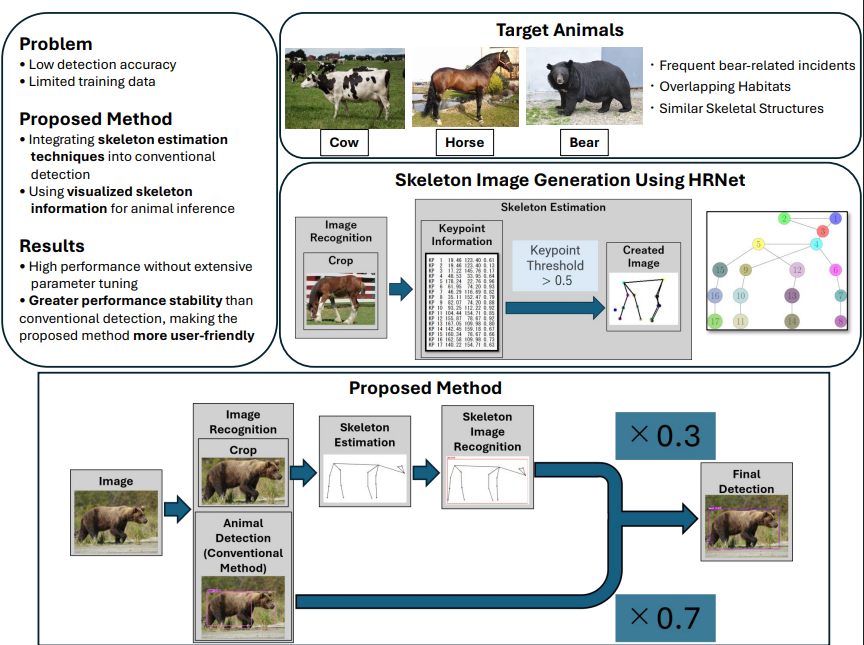
This paper presents a new harmful-animal detection method that combines conventional algorithms for image recognition with skeleton estimation techniques. In many places around the world, wild animals encroach on human territory, causing personal injury and damage to crops. One way to address this social problem is to implement a harmful-animal detection system using cameras and object detection algorithms; however, current methods face the challenge of low detection accuracy, limiting their practical application. This study aims to address this challenge through a novel approach that combines conventional algorithms for image recognition with skeleton estimation techniques. The proposed method uses transfer learning on two pre-trained models: YOLOv8—known for its high accuracy and real-time performance—and HRNet, a widely used model for animal skeleton estimation. For training, a dataset extracted from AP-10K was used. In the proposed method, animals in the input image are detected by combining the inference results from two image recognition algorithms. The initial result is obtained from the input image itself, while the subsequent result is derived from a skeleton image created by plotting estimated keypoints and connecting lines. The final inference result is weighted and combined to improve the accuracy of animal detection in the image. The proposed method was evaluated by comparing its detection results with those of a conventional detection method while varying the minimum confidence threshold (conf). The evaluation demonstrated that the proposed method performs as well as or better than the conventional detection method. Furthermore, the proposed method exhibited greater overall stability, which simplified the process of conf parameter adjustment, making it more user-friendly. These findings suggest that the proposed method can contribute to the development of a more practical and effective harmful-animal detection system.
References
Cao, J., Tang, H., Fang, H. S., Shen, X., Lu, C., & Tai, Y. W. (2019). Cross-domain adaptation for animal pose estimation. In Proceedings of the IEEE/CVF International Conference on Computer Vision (pp. 9498–9507).
Chen, K., Yu, Y., & Zhou, H. (2023). Animal movement prediction based on the corroboration of object detection and pose estimation. Highlights in Science, Engineering and Technology, 39, 997–1004. https://doi.org/10.54097/hset.v39i.6692
Dave, B., Mori, M., Bathani, A., & Goel, P. (2023). Wild animal detection using YOLOv8. Procedia Computer Science, 230, 100–111.
Jiang, L., Lee, C., Teotia, D., & Ostadabbas, S. (2022). Animal pose estimation: A closer look at the state-of-the-art, existing gaps and opportunities. Computer Vision and Image Understanding, 222, 103483.
Jocher, G., Qiu, J., & Chaurasia, A. (2023). Ultralytics YOLO (Version 8.0.0) [Computer software]. https://github.com/ultralytics/ultralytics
König, H. J., Ceaușu, S., Reed, M., Kendall, H., Hemminger, K., Reinke, H., Ostermann-Miyashita, E.-F., Wenz, E., Eufemia, L., Hermanns, T., Klose, M., Spyra, M., Kuemmerle, T., & Ford, A. T. (2021). Integrated framework for stakeholder participation: Methods and tools for identifying and addressing human–wildlife conflicts. Conservation Science and Practice, 3(3), e399.
Kumar, T., Brennan, R., Mileo, A., & Bendechache, M. (2024). Image data augmentation approaches: A comprehensive survey and future directions. IEEE Access, 12, 187536–187571.
MMPose Contributors. (2020). OpenMMLab pose estimation toolbox and benchmark. https://github.com/open-mmlab/mmpose
Mu, J., Qiu, W., Hager, G. D., & Yuille, A. L. (2020). Learning from synthetic animals. In Proceedings of the IEEE/CVF Conference on Computer Vision and Pattern Recognition (pp. 12386–12395).
Xin, L. Q., Mat Ghani, S. N. A., Rasudin, N. S., Abdul Ghafar, N., Abd Rashid, N. H., Ten, D. C. Y., Saaban, S., Edinur, H. A., & Abdullah, M. T. (2024). Characterisation of human–wildlife conflict and casualties caused by wildlife attacks in Peninsular Malaysia. IIUM Medical Journal Malaysia, 23(01), 83–90.
Yu, H., Xu, Y., Zhang, J., Zhao, W., Guan, Z., & Tao, D. (2021). AP-10k: A benchmark for animal pose estimation in the wild. arXiv preprint arXiv:2108.12617.
Downloads
Published
Issue
Section
License
Copyright (c) 2026 Malaysian Journal of Science (MJS)

This work is licensed under a Creative Commons Attribution-NonCommercial 4.0 International License.
Transfer of Copyrights
- In the event of publication of the manuscript entitled [INSERT MANUSCRIPT TITLE AND REF NO.] in the Malaysian Journal of Science, I hereby transfer copyrights of the manuscript title, abstract and contents to the Malaysian Journal of Science and the Faculty of Science, University of Malaya (as the publisher) for the full legal term of copyright and any renewals thereof throughout the world in any format, and any media for communication.
Conditions of Publication
- I hereby state that this manuscript to be published is an original work, unpublished in any form prior and I have obtained the necessary permission for the reproduction (or am the owner) of any images, illustrations, tables, charts, figures, maps, photographs and other visual materials of whom the copyrights is owned by a third party.
- This manuscript contains no statements that are contradictory to the relevant local and international laws or that infringes on the rights of others.
- I agree to indemnify the Malaysian Journal of Science and the Faculty of Science, University of Malaya (as the publisher) in the event of any claims that arise in regards to the above conditions and assume full liability on the published manuscript.
Reviewer’s Responsibilities
- Reviewers must treat the manuscripts received for reviewing process as confidential. It must not be shown or discussed with others without the authorization from the editor of MJS.
- Reviewers assigned must not have conflicts of interest with respect to the original work, the authors of the article or the research funding.
- Reviewers should judge or evaluate the manuscripts objective as possible. The feedback from the reviewers should be express clearly with supporting arguments.
- If the assigned reviewer considers themselves not able to complete the review of the manuscript, they must communicate with the editor, so that the manuscript could be sent to another suitable reviewer.
Copyright: Rights of the Author(s)
- Effective 2007, it will become the policy of the Malaysian Journal of Science (published by the Faculty of Science, University of Malaya) to obtain copyrights of all manuscripts published. This is to facilitate:
- Protection against copyright infringement of the manuscript through copyright breaches or piracy.
- Timely handling of reproduction requests from authorized third parties that are addressed directly to the Faculty of Science, University of Malaya.
- As the author, you may publish the fore-mentioned manuscript, whole or any part thereof, provided acknowledgement regarding copyright notice and reference to first publication in the Malaysian Journal of Science and Faculty of Science, University of Malaya (as the publishers) are given. You may produce copies of your manuscript, whole or any part thereof, for teaching purposes or to be provided, on individual basis, to fellow researchers.
- You may include the fore-mentioned manuscript, whole or any part thereof, electronically on a secure network at your affiliated institution, provided acknowledgement regarding copyright notice and reference to first publication in the Malaysian Journal of Science and Faculty of Science, University of Malaya (as the publishers) are given.
- You may include the fore-mentioned manuscript, whole or any part thereof, on the World Wide Web, provided acknowledgement regarding copyright notice and reference to first publication in the Malaysian Journal of Science and Faculty of Science, University of Malaya (as the publishers) are given.
- In the event that your manuscript, whole or any part thereof, has been requested to be reproduced, for any purpose or in any form approved by the Malaysian Journal of Science and Faculty of Science, University of Malaya (as the publishers), you will be informed. It is requested that any changes to your contact details (especially e-mail addresses) are made known.
Copyright: Role and responsibility of the Author(s)
- In the event of the manuscript to be published in the Malaysian Journal of Science contains materials copyrighted to others prior, it is the responsibility of current author(s) to obtain written permission from the copyright owner or owners.
- This written permission should be submitted with the proof-copy of the manuscript to be published in the Malaysian Journal of Science
Licensing Policy
Malaysian Journal of Science is an open-access journal that follows the Creative Commons Attribution-Non-commercial 4.0 International License (CC BY-NC 4.0)
CC BY – NC 4.0: Under this licence, the reusers to distribute, remix, alter, and build upon the content in any media or format for non-commercial purposes only, as long as proper acknowledgement is given to the authors of the original work. Please take the time to read the whole licence agreement (https://creativecommons.org/licenses/by-nc/4.0/legalcode ).