Forecasting Electricity Demand using Seasonal ARIMA and Asymmetric GARCH Models: A Case Study for Malaysia
DOI:
https://doi.org/10.22452/mjs.vol45sp2.1Keywords:
Forecasting Electricity Demand, ARIMA, GARCH, AsymmetricAbstract
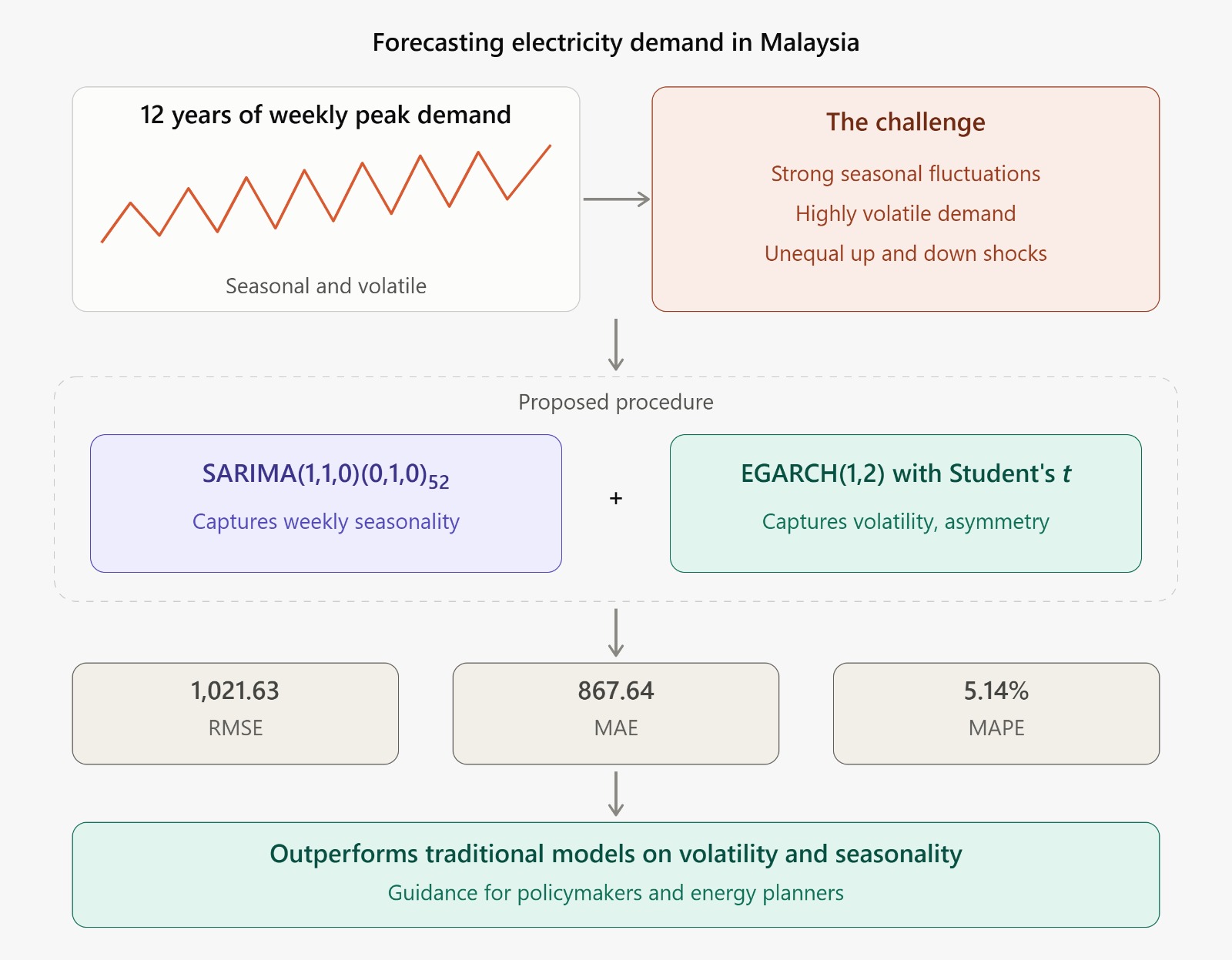
Accurate energy load forecasting is important for enhancing functionality and reliability of strategy development within the power generation industry. Electricity systems exhibit distinct reactions to positive and negative demand shocks, making asymmetric models particularly useful for capturing these variations. Incorporating asymmetric Generalized Autoregressive Conditional Heteroscedasticity (GARCH) models into electricity demand forecasting can enhance forecasting accuracy by capturing the responses to demand shocks. It has been demonstrated that non-seasonal Autoregressive Integrated Moving Average (ARIMA) with asymmetric GARCH-type model is promising for forecasting highly volatile data. However, Malaysia's electricity demand time series data exhibits strong seasonal fluctuations, necessitating the use of seasonal models. From this perspective, an evaluation is carried out in this study to determine the effectiveness of a seasonal ARIMA model combined with an asymmetric GARCH-type model for forecasting electricity demand in Malaysia. Additionally, it proposes a new procedure for forecasting electricity demand. This study utilized weekly peak electricity usage over the timeframe of 2005 to 2016. The results suggest the optimal combination of seasonal ARIMA with asymmetric GARCH-type model for electricity demand prediction is integrated with structure using Student’s t-distribution. This model was selected due to its simplicity and strong performance, reflected in its low error metrics: root mean squared error (RMSE) of 1021.6340, mean absolute error (MAE) of 867.6399, and mean absolute percentage error (MAPE) of 5.14%. The study demonstrates the model’s superiority in capturing volatility and seasonality compared to traditional approaches. Given its enhanced predictive performance, the proposed seasonal ARIMA with asymmetric GARCH-type model provides critical insights for policymakers and energy sector planners in forecasting electricity demand in Malaysia.
References
Akaike, H. (1974). A new look at the statistical model identification. IEEE Transactions on Automatic Control, 19(6), 716-723.
Al-Alawi, S. M., & Islam, S. M. (1996). Principles of electricity demand forecasting. I. Methodologies. Power Engineering Journal, 10(3), 139-143.
Andoh, P. Y. A., Sekyere, C. K. K., Mensah, L. D., & Dzebre, D. E. K. (2021). Forecasting electricity demand in Ghana with the SARIMA model. Journal of Applied Engineering and Technological Science, 3(1), 1-9.
Chalissery, N., Anagreh, S., Nishad T, M., & Tabash, M. I. (2022). Mapping the trend, application and forecasting performance of asymmetric GARCH models: a review based on bibliometric analysis. Journal of Risk and Financial Management, 15(9), 406.
Chatfield, C. (2001). Time-series forecasting. Retrieved from http://www.crcnetbase.com/isbn/9781584880639.
Chen, H., Zhang, J., Tao, Y., & Tan, F. (2019). Asymmetric GARCH type models for asymmetric volatility characteristics analysis and wind power forecasting. Protection and Control of Modern Power Systems, 4(4), 1-11.
Department of Statistics Malaysia. (2018). Malaysia's economic performance report (DOSM/BPPIB/1.2018/Series 10 (Electricity Sector in Malaysia)). Retrieved from https://www.dosm.gov.my/v1/uploads/files/6_Newsletter/newsletter%202018/Series%2010_Electricity%20Sector.pdf.
Duong, T. K., Phan, D. H., & Nguyen, D. M. (2023). Application of Sarima Model in Load Forecasting in Hanoi City. International Journal of Energy Economics and Policy, 13(3), 164-170.
Girish, G. P. (2016). Spot electricity price forecasting in Indian electricity market using autoregressive - GARCH models. Energy Strategy Reviews, 11(12), 52-57.
Goswami, K., & Kandali, A. B. (2020). Electricity demand prediction using data driven forecasting scheme: ARIMA and SARIMA for real-time load data of Assam. In 2020 International Conference on Computational Performance Evaluation (ComPE), IEEE, 570-574.
Hor, C. L., Watson, S. J., & Majithia, S. (2005). Analyzing the impact of weather variables on monthly electricity demand. IEEE transactions on power systems, 20(4), 2078-2085.
Ishak, I., Othman, N. S., & Harun, N. H. (2022). Forecasting electricity consumption of Malaysia’s residential sector: Evidence from an exponential smoothing model. F1000Research, 11(54), 54.
Kavaklioglu, K., Ceylan, H., Ozturk, H. K., & Canyurt, O. E. (2009). Modeling and prediction of Turkey’s electricity consumption using artificial neural networks. Energy Conversion and Management, 50(11), 2719-2727.
Keyno, H. S., Ghaderi, F., Azade, A., & Razmi, J. (2009). Forecasting electricity consumption by clustering data in order to decline the periodic variable’s affects and simplification the pattern. Energy Conversion and Management, 50(3), 829-836.
Lee, M. H. L., Ser, Y. C., Selvachandran, G., Thong, P. H., Cuong, L., Son, L. H., ... & Gerogiannis, V. C. (2022). A comparative study of forecasting electricity consumption using machine learning models. Mathematics, 10(8), 1329.
Lim, C. M., & Sek, S. K. (2013). Comparing the performances of GARCH-type models in capturing the stock market volatility in Malaysia. Procedia Economics and Finance, 5, 478-487.
Lisi, F., & Shah, I. (2020). Forecasting next-day electricity demand and prices based on functional models. Energy Systems, 11(4), 947-979.
Makobea, O. S. (2023). Analysing electricity consumption in South Africa using volatility forecasting models (Doctoral dissertation, North-West University (South Africa)).
McLeod, A. I. (1993). Parsimony, model adequacy and periodic correlation in time series forecasting. International Statistical Review/Revue Internationale de Statistique, 387-393.
Ndege, E. M., Muriithi, D. K., & Wagala, A. (2023). Application of Asymmetric-GARCH type models to the Kenyan exchange rates. European Journal of Mathematics and Statistics, 4(4), 78-92.
Qiu, Z. (2013). Electricity consumption prediction based on data mining techniques with particle swarm optimization. International Journal of Database Theory and Application, 6(5), 153-164.
Rakshit, D., Paul, R. K., Yeasin, M., Emam, W., Tashkandy, Y., & Chesneau, C. (2023). Modeling asymmetric volatility: A news impact curve approach. Mathematics, 11(13), 2793.
Schwarz, G. (1978). Estimating the dimension of a model. The Annals of Statistics, 6(2), 461-464.
Shah, I., Iftikhar, H., & Ali, S. (2022). Modeling and forecasting electricity demand and prices: A comparison of alternative approaches. Journal of Mathematics, 2022.
Taylor, J. W. (2010). Triple seasonal methods for short-term electricity demand forecasting. European Journal of Operational Research, 204(1), 139-152.
Tehrani, S., Juan, J., & Caro, E. (2022). Electricity spot price modeling and forecasting in European markets. Energies, 15(16), 5980.
Tsay, R. S. (2013). An Introduction to analysis of financial data with R. Hoboken, N.J: Wiley.
Wang, B., Huang, H., & Wang, X. (2012). A novel text mining approach to financial time series forecasting. Neurocomputing, 83, 136-145.
Yasmeen, F., & Sharif, M. (2014). Forecasting electricity consumption for Pakistan. International Journal of Emerging Technology and Advanced Engineering, 4(4), 496-503.
Yaziz, S. R. (2019). Modified Box-Jenkins and GARCH for Forecasting Highly Volatile Time Series Data, PhD Thesis, Universiti Malaysia Pahang.
Zaim, S, Yusoff, W. N. S. W., Mohamad, N. N., Radi, N. F. A., and Yaziz, S. R. (2023). Forecasting of electricity demand with seasonal highly volatile characteristics using Box-Jenkins - GARCH model”, MATEMATIKA, 39(3), 293-313.
Zaim, S., Yaziz, S. R., Zakaria, R., Mohamad, N. N., & Radi, N. F. A. (2025). Electricity demand forecasting in malaysia using seasonal Box-Jenkins model. Jurnal Teknologi (Sciences & Engineering), 87(2).
Downloads
Published
Issue
Section
License
Copyright (c) 2026 Malaysian Journal of Science (MJS)

This work is licensed under a Creative Commons Attribution-NonCommercial 4.0 International License.
Transfer of Copyrights
- In the event of publication of the manuscript entitled [INSERT MANUSCRIPT TITLE AND REF NO.] in the Malaysian Journal of Science, I hereby transfer copyrights of the manuscript title, abstract and contents to the Malaysian Journal of Science and the Faculty of Science, University of Malaya (as the publisher) for the full legal term of copyright and any renewals thereof throughout the world in any format, and any media for communication.
Conditions of Publication
- I hereby state that this manuscript to be published is an original work, unpublished in any form prior and I have obtained the necessary permission for the reproduction (or am the owner) of any images, illustrations, tables, charts, figures, maps, photographs and other visual materials of whom the copyrights is owned by a third party.
- This manuscript contains no statements that are contradictory to the relevant local and international laws or that infringes on the rights of others.
- I agree to indemnify the Malaysian Journal of Science and the Faculty of Science, University of Malaya (as the publisher) in the event of any claims that arise in regards to the above conditions and assume full liability on the published manuscript.
Reviewer’s Responsibilities
- Reviewers must treat the manuscripts received for reviewing process as confidential. It must not be shown or discussed with others without the authorization from the editor of MJS.
- Reviewers assigned must not have conflicts of interest with respect to the original work, the authors of the article or the research funding.
- Reviewers should judge or evaluate the manuscripts objective as possible. The feedback from the reviewers should be express clearly with supporting arguments.
- If the assigned reviewer considers themselves not able to complete the review of the manuscript, they must communicate with the editor, so that the manuscript could be sent to another suitable reviewer.
Copyright: Rights of the Author(s)
- Effective 2007, it will become the policy of the Malaysian Journal of Science (published by the Faculty of Science, University of Malaya) to obtain copyrights of all manuscripts published. This is to facilitate:
- Protection against copyright infringement of the manuscript through copyright breaches or piracy.
- Timely handling of reproduction requests from authorized third parties that are addressed directly to the Faculty of Science, University of Malaya.
- As the author, you may publish the fore-mentioned manuscript, whole or any part thereof, provided acknowledgement regarding copyright notice and reference to first publication in the Malaysian Journal of Science and Faculty of Science, University of Malaya (as the publishers) are given. You may produce copies of your manuscript, whole or any part thereof, for teaching purposes or to be provided, on individual basis, to fellow researchers.
- You may include the fore-mentioned manuscript, whole or any part thereof, electronically on a secure network at your affiliated institution, provided acknowledgement regarding copyright notice and reference to first publication in the Malaysian Journal of Science and Faculty of Science, University of Malaya (as the publishers) are given.
- You may include the fore-mentioned manuscript, whole or any part thereof, on the World Wide Web, provided acknowledgement regarding copyright notice and reference to first publication in the Malaysian Journal of Science and Faculty of Science, University of Malaya (as the publishers) are given.
- In the event that your manuscript, whole or any part thereof, has been requested to be reproduced, for any purpose or in any form approved by the Malaysian Journal of Science and Faculty of Science, University of Malaya (as the publishers), you will be informed. It is requested that any changes to your contact details (especially e-mail addresses) are made known.
Copyright: Role and responsibility of the Author(s)
- In the event of the manuscript to be published in the Malaysian Journal of Science contains materials copyrighted to others prior, it is the responsibility of current author(s) to obtain written permission from the copyright owner or owners.
- This written permission should be submitted with the proof-copy of the manuscript to be published in the Malaysian Journal of Science
Licensing Policy
Malaysian Journal of Science is an open-access journal that follows the Creative Commons Attribution-Non-commercial 4.0 International License (CC BY-NC 4.0)
CC BY – NC 4.0: Under this licence, the reusers to distribute, remix, alter, and build upon the content in any media or format for non-commercial purposes only, as long as proper acknowledgement is given to the authors of the original work. Please take the time to read the whole licence agreement (https://creativecommons.org/licenses/by-nc/4.0/legalcode ).