Diversity of Phytoplankton in The Mangrove Area of Kerteh River: A Preliminary Study
DOI:
https://doi.org/10.22452/mjs.vol45no1.3Keywords:
Phytoplankton, mangroves, diversity, Kerteh RiverAbstract
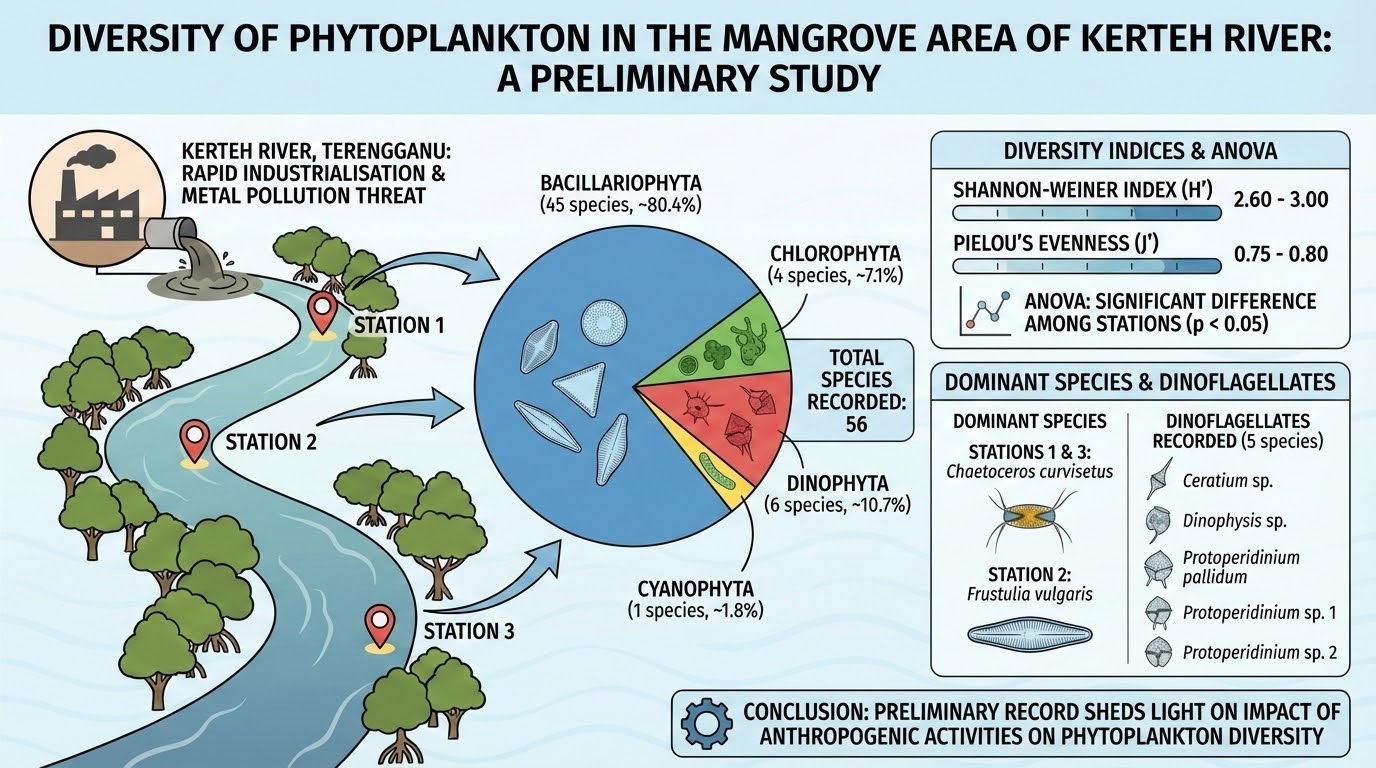
Mangroves, the world’s most productive ecosystem, harbour thousands of species of phytoplankton. Phytoplankton are the responsible microorganisms allowing mangroves to serve the ecosystem services. Unfortunately, this ecosystem is currently at threat due to various reasons. A study was carried out in a mangrove ecosystem at Kerteh River, Terengganu. Kerteh River is currently facing metal pollution problem that caused by the rapid industrialization. This problem is at high potential to directly impact the composition and abundance of phytoplankton. Therefore, this study was planned to determine the spatial species diversity of phytoplankton at three different stations at selected Kerteh River mangrove area. One off sampling was carried out for two days in August 2019. Three stations were established along the selected Kerteh River area based on the stations exposure to anthropogenic activities. Fifty-six phytoplankton species of four divisions were recorded in this present study. Forty-five species were of Bacillariophyta followed by four species of Chlorophyta, five species of Dinophyta and one species of Cyanophyta. The ranges of phytoplankton diversity indices (H’) and equitability (J’) at Kerteh River were 2.60 to 3.0 and 0.75 to 0.80, respectively. A One-Way Analysis of Variance (ANOVA) shows a significant different in the diversity of phytoplankton between stations (p<0.05). Chaetoceros curvisetus was the species with the highest relative abundance at Station 1 and 3, while at Station 2, it was the Frustulia vulgaris. There were five species of Dinoflagellate recorded at the study site, the Ceratium sp, Dinophysis sp., Protoperidinium pallidum, Protoperidinium sp1 and Protoperidinium sp2. The preliminary record on the phytoplankton species at Kerteh River hopefully can provide insight on the impact in the shift made by current and emerging anthropogenic activities at the area.
References
Ajibare, A. O., P. O. Ayeku, J. O. Akinola, and A. H. Adewale. (2019). Plankton Composition in Relation to Water Quality in the Coastal Waters of Nigeria. Asian Journal of Fisheries and Aquatic Research 5 (2):1-9. https://doi.org/10.9734/ajfar/2019/v5i230070.
Alvarez Dalinger, F. S., Claudia Nidia, B., Lozano, V. L., Moraña, L. B., & Salusso, M. M. (2024). Bloom-forming cyanobacteria and dinoflagellates in five Argentinian reservoirs: Multi-year sampling. Water Biology and Security, 3(1). https://doi.org/10.1016/j.watbs.2023.100232
Anne E Magurran. ([s.d.]). Measuring_Biological_Diversity (3).
Arsenieff, L., Simon, N., Rigaut-Jalabert, F., Le Gall, F., Chaffron, S., Corre, E., Com, E., Bigeard, E., & Baudoux, A. C. (2019). First viruses infecting the marine diatom Guinardia delicatula. Frontiers in Microbiology, 10 (JAN). https://doi.org/10.3389/fmicb.2018.03235
Azaman, F., Juahir, H., Yunus, K., Azid, A., Khalit, S. I., Mustafa, A. D., & Yusri, M. A. M. (2017). Metal concentration at surface water using multivariate analysis and human health risk assessment. Journal of Fundamental and Applied Sciences, 9(2S), 217-237.
Begum, M., Sahu, B. K., Das, A. K., Vinithkumar, N. V., & Kirubagaran, R. (2015). Extensive Chaetoceros curvisetus bloom in relation to water quality in Port Blair Bay, Andaman Islands. Environmental Monitoring and Assessment 187(5), 1–14. https://doi.org/10.1007/s10661-015-4461-2
Bellinger, E. G., & Sigee, D. C. (2010). Algae as Bioindicators. Em Freshwater Algae (p. 99–136). John Wiley & Sons, Ltd. https://doi.org/10.1002/9780470689554.ch3
Bosak, S., Godrijan, J., & Šilović, T. (2016). Dynamics of the marine planktonic diatom family Chaetocerotaceae in a Mediterranean coastal zone. Estuarine, Coastal and Shelf Science 180: 69–81. https://doi.org/10.1016/j.ecss.2016.06.026
Canini, N. D., Metillo, E. B., & Azanza, R. V. (2013). Monsoon-influenced phytoplankton community structure in a Philippine mangrove estuary. Tropical Ecology, 54(3): 331–343.
Chowdhury, A.J., Mohamed, A.A., John, A., & Yunus, K.B. (2011). Spatial Variation and Community Composition of Phytoplankton along the Pahang Estuary, Malaysia. Asian Journal of Biological Sciences, 4, 468-476.
C.K., H., Hardikar, R., Thomas, J., Pradhan, U. K., T.A., A., P.S., R., M.A., V., Sahu, B., & Rafeeq, M. (2022). Bloom report of Noctiluca scintillans, Gymnodinium wulfii and Guinardia delicatula from Shastri Estuary, West Coast of India. Regional Studies in Marine Science 56: 102689. https://doi.org/10.1016/j.rsma.2022.102689
Essien, T. P., S. P. Antai & N. U. Benson. 2007. Microalgae biodiversity and biomass status in Qua Iboe Estuary Mangrove Swamp, Nigeria. Aquatic Ecology 42: 71-81.
Ettoubi, E., Akif, F., Blaghen, M., & Genten, F. (2020). Marine Biotoxins: Origins, Effects, Distribution, Prevention and Treatment. In International Journal of Innovative Science and Research Technology (Vol. 5, Issue 11). www.ijisrt.com928
Evans JH. 1972. A modified sedimentation system for counting algae with an inverted microscope. Hydrobiologia 40: 247-250. DOI: 10.1007/BF00016796
Fang, X., & Sommer, U. (2017). Overwintering effects on the spring bloom dynamics of phytoplankton. Journal of Plankton Research 39(5), 772–780. https://doi.org/10.1093/plankt/fbx046
Flynn, R. F., Haraguchi, L., Mcquaid, J., Burger, J. M., Lunga, P. M., Stirnimann, L., Samanta, S., Roychoudhury, A. N., & Fawcett, S. E. (2023). Oceanography Nanoplankton: The dominant vector for carbon export across the Atlantic Southern Ocean in spring. https://oceancolor.gsfc.nasa.gov/l3/
Graham, L. E. & L. W. Wilcox. 2000. Algae. Prentice Hall. New Jersey.
Hammer, Ø., Harper, D.A.T., Ryan, P.D. 2001. PAST: Paleontological statistics software package for education and data analysis. Palaeontologia Electronica 4(1): 9pp.
Haridevi, C.K., Hardikar, R., Thomas, J., Pradhan, U. K., T.A., A., P.S., R., M.A., V., Sahu, B., & Rafeeq, M. (2022). Bloom report of Noctiluca scintillans, Gymnodinium wulfii and Guinardia delicatula from Shastri Estuary, West Coast of India. Regional Studies in Marine Science 56: 102689. https://doi.org/10.1016/j.rsma.2022.102689
Hilaluddin, F., Yusoff, F. M., Natrah, F. M. I., & Lim, P. T. (2020). Disturbance of mangrove forests causes alterations in estuarine phytoplankton community structure in Malaysian Matang mangrove forests. Marine Environmental Research 158. https://doi.org/10.1016/j.marenvres.2020.104935
Hilaluddin, F., Yusoff, F. M., & Toda, T. (2020). Shifts in diatom dominance associated with seasonal changes in an estuarine-mangrove phytoplankton community. Journal of Marine Science and Engineering 8(7). https://doi.org/10.3390/JMSE8070528
Jeslin, I. J., Benny, N., Thomas, L. C., & Padmakumar, K. B. (2021). Short term spatio-temporal variabilities of microphytobenthic assemblages in the mangrove ecosystems along the southwest coast of India. Wetlands Ecology and Management 29(5): 689–702. https://doi.org/10.1007/s11273-021-09787-8
Kamal, A. H. M., Idris, M. H., Al-Asif, A., Bhuiyan, M. K. A., Rasdi, N. W., Piah, R. M., Lah, R. A., Musa, N., Wahid, M. E. A., & Abualreesh, M. H. (2022). Phytoplankton Community Structure and Seasonality in a Tropical Mangrove Estuarine and Coastal Waters, South China Sea. Thalassas, 38(1), 511–526. https://doi.org/10.1007/s41208-021-00386-1
Lau, W. L. S, Lawa, I. K., Liow, G. R., Hiia, K. S., Usup, G., Lim, P. T. and Leaw, C. P. (2017). Life-history stages of natural bloom populations and the bloom dynamics of a tropical Asian ribotype of Alexandrium minutum. Harmful Algae, 70, 52-63
Law, I.K., Hii, K.S., Lau, W.L.S., Leaw, C.P., & Lim, P.T. (2023). Coastal micro-phytoplankton community changes during the toxigenic Alexandrium minutum blooms in a semi-enclosed tropical coastal lagoon (Malaysia, South China Sea). Reg. Stud. Mar. Sci. 57: 102733
Lim, P. T., Usup, G., & Leaw, C. P. (2012). Harmful algal blooms in Malaysian waters. Sains Malaysiana 41: 1509-1515.
Lim, H. C., Leaw, C. P., Tan, T. H., Kon, N. F., Yek, L. H., Hii, K. S., Teng, S. T., Razali, R. M., Usup, G., Iwataki, M., & Lim, P. T. (2014). A bloom of Karlodinium australe (Gymnodiniales, Dinophyceae) associated with mass mortality of cage-cultured fishes in West Johor Strait, Malaysia. Harmful Algae 40: 51-62.
Liow GR, Lau WLS, Law IK, Hii KS, Mohammad Noor N, Leaw CP, Lim PT (2019) Phytoplankton community changes in Kuantan Port (Malaysia), with emphasis on the paralytic-shellfish toxinproducing dinoflagellate Alexandrium tamiyavanichii. Reg Stud Mar Sci 26:100504. https://doi.org/10.1016/j.rsma.2019.100504
Magurran, A. E. (2004). Measuring_Biological_Diversity, pp. 215, Blackwell Publishing Company.
Manna, S., K. Chaudhuri, S. Bhattacharyya & M. Bhattacharyya, 2010. Dynamics of Sundarban estuarine ecosystem: eutrophication induced threat to mangroves. Saline System 6: 1-16.
Murty, K. N., Sarma, N. S., Pandi, S. R., Chiranjeevulu, G., Kiran, R., & Muralikrishna, R. (2017). Hydrodynamic control of microphytoplankton bloom in a coastal sea. Journal of Earth System Science, 126(6), 82. https://doi.org/10.1007/s12040-017-0867-2
Mohd-Din, M., Hii, K.S., Abdul-Wahab, M.F., Mohamad, S.E., Gu, H., Leaw, C.P., & Lim, P.T. (2022) Spatial-temporal variability of microphytoplankton assemblages including harmful microalgae in a tropical semi-enclosed strait (Johor Strait, Malaysia). Mar. Environ. Res. 175: 105589. https://doi.10.1016/j.marenvres.2022.105589
Mohammad-Noor, N., Adam, A., Lim, P. T., Leaw, C. P., Lau, W. L. S., Liow, G. R., Mohammad-Bunnori, N., Hamdan, N. A., Md-Noor, A., Kemat, N., & Muniandi, D. (2018). First report of paralytic shellfish poisoning (PSP) caused by Alexandrium tamiyavanichii in Kuantan Port, Pahang, East Coastof Malaysia. Phycological Research 66: 37-44
Mohd-Razali R. M., Mustapa N. I., Noordin W. N., Rahim M. A., Hii K. S., Lim P. T., Leaw, C. P., Muhd-Farouk, H., & Ku-Yaacob, K. (2022). Report of a fish kill due to a dinoflagellate bloom in Perak and Penang, Malaysia. Asian Fish. Sci. 35: 257–268.
Norhana Noordin, W., Nor Azman Ayub, M., Nor, A., & Mui Hua, L. ([s.d.]). Marine Biotoxins in Malaysia: Occurrence, Toxicity Cases, Analytical Capabilities and Regulatory Limits.
Onitsuka, G., Yoshikawa, Y., Shikata, T., Yufu, K., Abe, K., Tokunaga, T., Kimoto, K., & Matsuno, T. (2018). Development of a thin diatom layer observed in a stratified embayment in Japan. Journal of Oceanography, 74(4), 351–365. https://doi.org/10.1007/s10872-018-0466-0
Odido, M.; Appeltans, W.; BelHassen, M.; Mussai, P.; Nsiangango, S.E.; Vandepitte, L.; Wambiji, N.; Zamouri, N. Jiddou, A.M. (Eds) (2024). African Register of Marine Species. Frustulia cuspidata Kutzing,1833.Accessedat:https://www.marinespecies.org/afremas/aphia.php?p=taxdetails&id=163908 on 2024-09-10
Owen, R. B., R. W. Renaut, V. C. Hover, G. M. Ashley & A. M. Muasya. (2004). Swamps, springs and diatoms: wetlands o the semi-arid Bogoria-baringo Rift, Kenya. Hydrobiologia 518: 59-78.
Perumal, N. V., M. Rajkumar, P. Perumal & K. T Rajasekar. (2009). Seasonal variations of plankton diversity in Kaduviyar estuary, Nagapattinam, southeast coast of India. Journal of Environmental Biology 30: 1035-1046.ES
Rajkumar, M., P. Perumal, V. Ashok Prabu, N. Vengadesh Perumal & K. Thillai Rajasekar. (2009). Phytoplankton diversity in Pichavaram mangrove waters from south-east coast of India. Journal of Environmental Biology 30: 489-498.
Razali, R. M., Leaw, C. P., Lim, H. C., Nyanti, L., Ishak, I., & Lim, P. T. (2015). Harmful microalgae assemblage in the aquaculture area of Aman Island, Northen Strait of Malacca. Malaysian Journal of Science, 34(1), 20–32.
Razali, R.M., Mustapa, N.I., Yaacob, K.K.K., Yusof, F., Teng, S.T., Hanafiah, A.H., Hii, K.S., Mohd-Din, M., Gu, H., Leaw, C.P., & Lim, P. T. (2022). Diversity of Heterocapsa (Dinophyceae) and the algal bloom event in the mariculture areas of Johor Strait, Malaysia. Plankton Benthos Res. 17: 290–300.
Redzuan, N. S. (2012). Spatial and temporal distribution of phytoplankton at Carey Island mangrove. University of Malaya.
Redzuan, N. S., & Milow, P. (2021). Monthly chaetocerotales diversity and abundance, and its relationship with water physicochemical parameters and phytoplankton diversity in Carey Island mangrove ecosystem, Malaysia. Biodiversitas, 22(7), 2919–2927. https://doi.org/10.13057/biodiv/d220744
Saifullah, A. S. M., Hena, M. K. A., Idris, M. H., Halimah, A. R., & Johan, I. (2014). Diversity of Phytoplankton from Mangrove Estuaries of Sarawak, Malaysia. 31(5), 915–924. https://doi.org/10.5829/idosi.wasj.2014.31.05.2010
Saifullah, A.S., Kamal, A.H., Idris, M.H., Rajaee, A.H., & Bhuiyan, M.K. (2016). Phytoplankton in tropical mangrove estuaries: role and interdependency. Forest Science and Technology, 12, 104 - 113.
Salleh, A., Tajuddin, Z. M. (2006). Phytoplankton of Carey Island. Golden Hope Plantations Berhad and Institute of Biological Sciences (UM). 207 pp.
Saravanakumar, A., Rajkumar, M., Thivakaran, G. A., & Sesh Serebiah, J. (2008). Abundance and seasonal variations of phytoplankton in the creek waters of western mangrove of Kachchh-Gujarat. Journal of Environmental Biology, 29(2), 271–274.
Shao, Q., Zhu, Z., & Zhou, C. (2023). Alteration in Community Dynamics of Chaetoceros curvisetus and Bacterioplankton Communities in Response to Surfactin Exposure. Microorganisms, 11(10). https://doi.org/10.3390/microorganisms11102596
Somsap, N., Gajaseni, N., & Piumsomboon, A. (2015). Physico-Chemical Factors Influencing Blooms of Chaetoceros spp. and Ceratium furca in the Inner Gulf of Thailand. Em Nat. Sci.) (Vol. 49).
Spaulding, S. A., Potapova, M. G., Bishop, I. W., Lee, S. S., Gasperak, T. S., Jovanoska, E., Furey, P. C., & Edlund, M. B. (2021). Diatoms.org: supporting taxonomists, connecting communities. Diatom Research, 36(4), 291–304. https://doi.org/10.1080/0269249X.2021.2006790
Stanković, I., Gligora Udovič, M., Žutinić, P., Hanžek, N., & Plenković-Moraj, A. (2024). Is salinity a driving factor for the phytoplankton community structure of a brackish shallow Mediterranean lake? Hydrobiologia, 851(4), 999–1013. https://doi.org/10.1007/s10750-023-05300-9
Supriatna, J. (2018). Biodiversity Indexes: Value and Evaluation Purposes. E3S Web of Conferences, 48. https://doi.org/10.1051/e3sconf/20184801001
Tanaka, K. & P. Choo. 2000. Influences of nutrient outwelling from the mangrove swamp on the distribution of phytoplankton in the Matang Mangrove Estuary, Malaysia. Journal of Oceanography 56: 69-78
Taucher, J., Arístegui, J., Bach, L. T., Guan, W., Montero, M. F., Nauendorf, A., Achterberg, E. P., & Riebesell, U. (2018). Response of subtropical phytoplankton communities to ocean acidification under oligotrophic conditions and during nutrient fertilization. Frontiers in Marine Science, 5(SEP). https://doi.org/10.3389/fmars.2018.00330
Underwood, G. J. C. (1995). Seasonal and spatial variation in epipelic diatom assemblages in the Severn Estuary. Oceanographic Literature Review, 42(7), 559–560.
United Nations, Department of Economic and Social Affairs, Population Division (2019). World Population Prospects 2019, Volume I: Comprehensive Tables (ST/ESA/SER.A/426).
Usup, G., Leaw, C. P., Lim, P. T., & Ahmad, A. (2002). Probable toxin producer responsible for the first occurrence of paralytic shellfish poisoning on the east coast of peninsula Malaysia. Malaysian Applied Biology 31(2): 29-35
Utami, F., Hasan, Z., Rizal, A., & Herawati, H. (2019). Spatial distribution of plankton in Cikeruh River, Jatinangor District, West Java Province, Indonesia. Asian Journal of Fisheries and Aquatic Research, 1-9.
Xu, S. J.-L., Chan, S. C.-Y., Wong, B. Y.-K., Zhou, H.-C., Li, F.-L., Tam, N. F.-Y., & Lee, F. W.-F. (2022). Relationship between phytoplankton community and water parameters in planted fringing mangrove area in South China. Science of The Total Environment, 817, 152838. https://doi.org/https://doi.org/10.1016/j.scitotenv.2021.152838
Yaakob, F. K. K., & Zakaria, M. P. (2017). Determination of heavy metals in water samples from Sungai Kerteh and Sungai Paka, Terengganu, Malaysia. Journal of Tropical Resource and Sustainable Science, 5 ,74-78.
Yñiguez, A. T., Lim, P. T., Leaw, C. P., Jipanin, S. J., Iwataki, M., Benico, G. & Azanza, R. V. (2021). Over 30 years of HABs in the Philippines and Malaysia: What have we learned? Harmful Algae 102: 101776. https://doi.org/10.1016/j.hal.2020.101776
Downloads
Published
Issue
Section
License
Copyright (c) 2026 Malaysian Journal of Science (MJS)

This work is licensed under a Creative Commons Attribution-NonCommercial 4.0 International License.
Transfer of Copyrights
- In the event of publication of the manuscript entitled [INSERT MANUSCRIPT TITLE AND REF NO.] in the Malaysian Journal of Science, I hereby transfer copyrights of the manuscript title, abstract and contents to the Malaysian Journal of Science and the Faculty of Science, University of Malaya (as the publisher) for the full legal term of copyright and any renewals thereof throughout the world in any format, and any media for communication.
Conditions of Publication
- I hereby state that this manuscript to be published is an original work, unpublished in any form prior and I have obtained the necessary permission for the reproduction (or am the owner) of any images, illustrations, tables, charts, figures, maps, photographs and other visual materials of whom the copyrights is owned by a third party.
- This manuscript contains no statements that are contradictory to the relevant local and international laws or that infringes on the rights of others.
- I agree to indemnify the Malaysian Journal of Science and the Faculty of Science, University of Malaya (as the publisher) in the event of any claims that arise in regards to the above conditions and assume full liability on the published manuscript.
Reviewer’s Responsibilities
- Reviewers must treat the manuscripts received for reviewing process as confidential. It must not be shown or discussed with others without the authorization from the editor of MJS.
- Reviewers assigned must not have conflicts of interest with respect to the original work, the authors of the article or the research funding.
- Reviewers should judge or evaluate the manuscripts objective as possible. The feedback from the reviewers should be express clearly with supporting arguments.
- If the assigned reviewer considers themselves not able to complete the review of the manuscript, they must communicate with the editor, so that the manuscript could be sent to another suitable reviewer.
Copyright: Rights of the Author(s)
- Effective 2007, it will become the policy of the Malaysian Journal of Science (published by the Faculty of Science, University of Malaya) to obtain copyrights of all manuscripts published. This is to facilitate:
- Protection against copyright infringement of the manuscript through copyright breaches or piracy.
- Timely handling of reproduction requests from authorized third parties that are addressed directly to the Faculty of Science, University of Malaya.
- As the author, you may publish the fore-mentioned manuscript, whole or any part thereof, provided acknowledgement regarding copyright notice and reference to first publication in the Malaysian Journal of Science and Faculty of Science, University of Malaya (as the publishers) are given. You may produce copies of your manuscript, whole or any part thereof, for teaching purposes or to be provided, on individual basis, to fellow researchers.
- You may include the fore-mentioned manuscript, whole or any part thereof, electronically on a secure network at your affiliated institution, provided acknowledgement regarding copyright notice and reference to first publication in the Malaysian Journal of Science and Faculty of Science, University of Malaya (as the publishers) are given.
- You may include the fore-mentioned manuscript, whole or any part thereof, on the World Wide Web, provided acknowledgement regarding copyright notice and reference to first publication in the Malaysian Journal of Science and Faculty of Science, University of Malaya (as the publishers) are given.
- In the event that your manuscript, whole or any part thereof, has been requested to be reproduced, for any purpose or in any form approved by the Malaysian Journal of Science and Faculty of Science, University of Malaya (as the publishers), you will be informed. It is requested that any changes to your contact details (especially e-mail addresses) are made known.
Copyright: Role and responsibility of the Author(s)
- In the event of the manuscript to be published in the Malaysian Journal of Science contains materials copyrighted to others prior, it is the responsibility of current author(s) to obtain written permission from the copyright owner or owners.
- This written permission should be submitted with the proof-copy of the manuscript to be published in the Malaysian Journal of Science
Licensing Policy
Malaysian Journal of Science is an open-access journal that follows the Creative Commons Attribution-Non-commercial 4.0 International License (CC BY-NC 4.0)
CC BY – NC 4.0: Under this licence, the reusers to distribute, remix, alter, and build upon the content in any media or format for non-commercial purposes only, as long as proper acknowledgement is given to the authors of the original work. Please take the time to read the whole licence agreement (https://creativecommons.org/licenses/by-nc/4.0/legalcode ).