Utilizing Black Turtle Beans (Phaseolus Vulgaris) for Enhanced Natto Production: A Promising Alternative to Soybeans
DOI:
https://doi.org/10.22452/mjs.vol45no1.2Keywords:
Bacillus subtilis, black turtle beans, fibrinolytic activity, nattokinase, soy allergiesAbstract
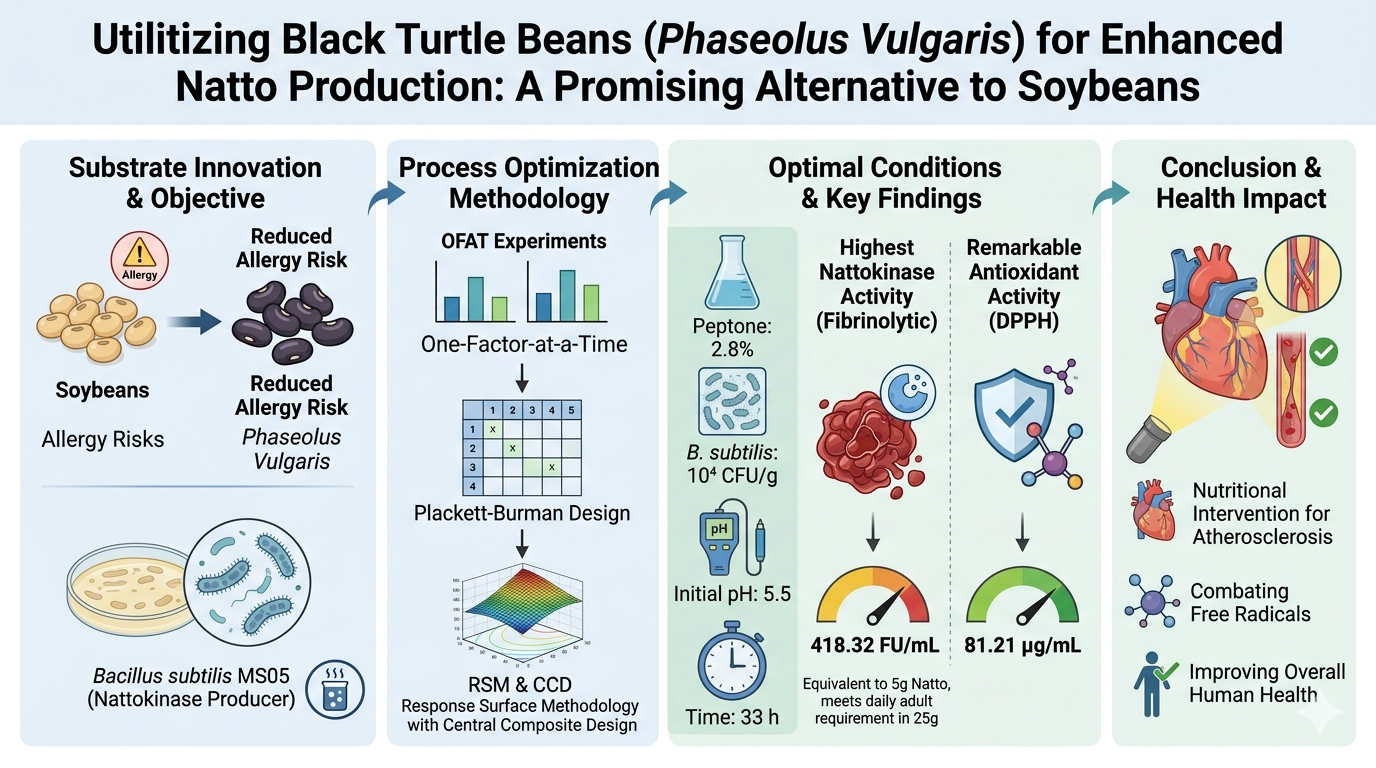
This study aims to replace soybeans, which pose allergy risks, with black turtle beans as a fermentation substrate for natto production. Bacillus subtilis MS05, known for its production of the fibrinolytic enzyme nattokinase, was employed to determine the optimal fermentation conditions. This was achieved through a multifaceted approach, incorporating one-factor-at-a-time experiments, a Plackett-Burman experimental design, as well as a response surface methodology with central composite design. The study reported the highest fibrinolytic activity at 418.32 FU/mL, which is equivalent to the nattokinase enzyme activity found in 5g of natto. This is sufficient to meet the daily nattokinase requirement of an adult consuming 25g of natto. Key factors that significantly influenced the fermentation process were identified as a peptone concentration of 2.8%, a bacterial density of 10⁴ CFU/g of Bacillus subtilis, an initial pH of 5.5, and a fermentation duration of 33 hours. Additionally, natto produced from black turtle beans exhibited remarkable antioxidant activity, as indicated by a DPPH activity of 81.21 µg/mL. These findings highlight the significant potential of black turtle bean-based natto in enhancing fibrinolytic activity and effectively combating free radicals. These attributes contribute to the treatment of atherosclerotic blood clots and hold promise for improving overall human health by nutritional interventions.
References
Amin, K., Zeng, X., You, Y., Hu, Y., Sun, H., Lyu, B., ... & Yu, H. (2020). Enhanced thermostability and antioxidant activity of Nattokinase by biogenic enrichment of selenium. Journal of Food Measurement and Characterization, 14(4), 2145-2154.
Barriada-Bernal, L. G., Almaraz-Abarca, N., Delgado-Alvarado, E. A., Gallardo-Velázquez, T., Ávila-Reyes, J. A., Torres-Morán, M. I., ... & Herrera-Arrieta, Y. (2014). Flavonoid composition and antioxidant capacity of the edible flowers of Agave durangensis (Agavaceae). CyTA-Journal of Food, 12(2), 105-114.
Bharose, A. A., Gajera, H. P., Hirpara, D. G., Kachhadia, V. H., & Golakiya, B. A. (2017). Molecular identification and characterization of bacillus antagonist to inhibit aflatoxigenic Aspergillus flavus. Int. J. Curr. Miocrobiol. Appl. Sci, 6(3), 2466-2484.
Deepak, V., Kalishwaralal, K., Ramkumarpandian, S., Babu, S. V., Senthilkumar, S. R., & Sangiliyandi, G. (2008). Optimization of media composition for Nattokinase production by Bacillus subtilis using response surface methodology. Bioresource Technology, 99(17), 8170-8174.
He, S., Zhao, J., Zhang, Y., Zhu, Y., Li, X., Cao, X., ... & Sun, H. (2021). Effects of low-pH treatment on the allergenicity reduction of black turtle bean (Phaseolus vulgaris L.) lectin and its mechanism. Journal of agricultural and food chemistry, 69(4), 1379-1390.
Hmood, S. A., & Aziz, G. M. (2016). Optimum conditions for fibrinolytic enzyme (Nattokinase) production by Bacillus sp. B24 using solid state fermentation. Iraqi Journal of Science, 1391-1401.
Hmood, S. A., & Aziz, G. M. (2016). Purification and characterization of nattokinase produced by local isolate of Bacillus sp. B24. Iraqi journal of Biotechnology, 15(2).
Hui, Y. H., Meunier-Goddik, L., Josephsen, J., Nip, W. K., & Stanfield, P. S. (Eds.). (2004). Handbook of food and beverage fermentation technology (Vol. 134). CRC Press.
Inomata, N., Osuna, H., Kawano, K., Yamaguchi, J., Yanagimachi, M., Matsukura, S., & Ikezawa, Z. (2007). Late-onset anaphylaxis after ingestion of Bacillus Subtilis-fermented soybeans (Natto): clinical review of 7 patients. Allergology international, 56(3), 257-261.
Liu, J., Xing, J., Chang, T., Ma, Z., & Liu, H. (2005). Optimization of nutritional conditions for nattokinase production by Bacillus natto NLSSE using statistical experimental methods. Process Biochemistry, 40(8), 2757-2762.
Nguyen, V. T., Tran, L. H., & Le, Q. H. (2022). Optimization of Nattokinase Production from Bacillus subtilis Using Response Surface Methodology. International Journal of Science, Engineering and Applied Science, 8(8), 1-10.
Platteau, C., Cucu, T., De Meulenaer, B., Devreese, B., De Loose, M., & Taverniers, I. (2011). Effect of protein glycation in the presence or absence of wheat proteins on detection of soybean proteins by commercial ELISA. Food Additives and Contaminants, 28(2), 127-135.
Pradhananga, M. (2019). Effect of processing and soybean cultivar on natto quality using response surface methodology. Food Science & Nutrition, 7(1), 173-182.
Roth, G. A., Abate, D., Abate, K. H., Abay, S. M., Abbafati, C., Abbasi, N., ... & Borschmann, R. (2018). Global, regional, and national age-sex-specific mortality for 282 causes of death in 195 countries and territories, 1980–2017: a systematic analysis for the Global Burden of Disease Study 2017. The lancet, 392(10159), 1736-1788.
Sambrook, J., & Russell, D. W. (2001). Molecular Cloning: A Laboratory Manual 3rd ed. Chapter 6. Isolation of DNA Fragments from Polyacrylamide Gels by the Crush and Soak Method.
Sumi, H., Naito, S., Yatagai, C., Mitsuo, T (2022). Strong Fibrinolysis with New Fermented Foods (Mung Bean Natto and Natto Miso). The International Society on Thrombosis and Haemostasis 2022 Congress in London, England, U.K. Abstract number: VPB0639.
Suwanmanon, K., & Hsieh, P. C. (2014). Isolating Bacillus subtilis and optimizing its fermentative medium for GABA and nattokinase production. CyTA-Journal of Food, 12(3), 282-290.
Tran, Q. T., Nguyen, T. T. K., Le, T. T. A., Dinh, M. H., & Tran, C. D. (2014). Optimization of medium composition for recombinant nattokinase production from Bacillus subtilis by using response surface methodology. Academia Journal of Biology, 36(1se), 130-137.
Wang, C., Chen, J., Tian, W., Han, Y., Xu, X., Ren, T., ... & Chen, C. (2023). Natto: A medicinal and edible food with health function. Chinese Herbal Medicines.
Wang, J. K., Chiu, H. H., & Hsieh, C. S. (2009). Optimization of the medium components by statistical experimental methods to enhance nattokinase activity. Fooyin Journal of Health Sciences, 1(1), 21-27.
Wang, Q., & Zennadi, R. (2020). Oxidative stress and thrombosis during aging: the roles of oxidative stress in RBCs in venous thrombosis. International journal of molecular sciences, 21(12), 4259.
Yanagisawa, Y., Chatake, T., Chiba-Kamoshida, K., Naito, S., Ohsugi, T., Sumi, H., ... & Morimoto, Y. (2010). Purification, crystallization and preliminary X-ray diffraction experiment of nattokinase from Bacillus subtilis natto. Acta Crystallographica Section F: Structural Biology and Crystallization Communications, 66(12), 1670-1673.
Yang, Y., Lan, G., Tian, X., He, L., Li, C., Zeng, X., & Wang, X. (2021). Effect of fermentation parameters on natto and its thrombolytic property. Foods, 10(11), 2547.
Downloads
Published
Issue
Section
License
Copyright (c) 2026 Malaysian Journal of Science (MJS)

This work is licensed under a Creative Commons Attribution-NonCommercial 4.0 International License.
Transfer of Copyrights
- In the event of publication of the manuscript entitled [INSERT MANUSCRIPT TITLE AND REF NO.] in the Malaysian Journal of Science, I hereby transfer copyrights of the manuscript title, abstract and contents to the Malaysian Journal of Science and the Faculty of Science, University of Malaya (as the publisher) for the full legal term of copyright and any renewals thereof throughout the world in any format, and any media for communication.
Conditions of Publication
- I hereby state that this manuscript to be published is an original work, unpublished in any form prior and I have obtained the necessary permission for the reproduction (or am the owner) of any images, illustrations, tables, charts, figures, maps, photographs and other visual materials of whom the copyrights is owned by a third party.
- This manuscript contains no statements that are contradictory to the relevant local and international laws or that infringes on the rights of others.
- I agree to indemnify the Malaysian Journal of Science and the Faculty of Science, University of Malaya (as the publisher) in the event of any claims that arise in regards to the above conditions and assume full liability on the published manuscript.
Reviewer’s Responsibilities
- Reviewers must treat the manuscripts received for reviewing process as confidential. It must not be shown or discussed with others without the authorization from the editor of MJS.
- Reviewers assigned must not have conflicts of interest with respect to the original work, the authors of the article or the research funding.
- Reviewers should judge or evaluate the manuscripts objective as possible. The feedback from the reviewers should be express clearly with supporting arguments.
- If the assigned reviewer considers themselves not able to complete the review of the manuscript, they must communicate with the editor, so that the manuscript could be sent to another suitable reviewer.
Copyright: Rights of the Author(s)
- Effective 2007, it will become the policy of the Malaysian Journal of Science (published by the Faculty of Science, University of Malaya) to obtain copyrights of all manuscripts published. This is to facilitate:
- Protection against copyright infringement of the manuscript through copyright breaches or piracy.
- Timely handling of reproduction requests from authorized third parties that are addressed directly to the Faculty of Science, University of Malaya.
- As the author, you may publish the fore-mentioned manuscript, whole or any part thereof, provided acknowledgement regarding copyright notice and reference to first publication in the Malaysian Journal of Science and Faculty of Science, University of Malaya (as the publishers) are given. You may produce copies of your manuscript, whole or any part thereof, for teaching purposes or to be provided, on individual basis, to fellow researchers.
- You may include the fore-mentioned manuscript, whole or any part thereof, electronically on a secure network at your affiliated institution, provided acknowledgement regarding copyright notice and reference to first publication in the Malaysian Journal of Science and Faculty of Science, University of Malaya (as the publishers) are given.
- You may include the fore-mentioned manuscript, whole or any part thereof, on the World Wide Web, provided acknowledgement regarding copyright notice and reference to first publication in the Malaysian Journal of Science and Faculty of Science, University of Malaya (as the publishers) are given.
- In the event that your manuscript, whole or any part thereof, has been requested to be reproduced, for any purpose or in any form approved by the Malaysian Journal of Science and Faculty of Science, University of Malaya (as the publishers), you will be informed. It is requested that any changes to your contact details (especially e-mail addresses) are made known.
Copyright: Role and responsibility of the Author(s)
- In the event of the manuscript to be published in the Malaysian Journal of Science contains materials copyrighted to others prior, it is the responsibility of current author(s) to obtain written permission from the copyright owner or owners.
- This written permission should be submitted with the proof-copy of the manuscript to be published in the Malaysian Journal of Science
Licensing Policy
Malaysian Journal of Science is an open-access journal that follows the Creative Commons Attribution-Non-commercial 4.0 International License (CC BY-NC 4.0)
CC BY – NC 4.0: Under this licence, the reusers to distribute, remix, alter, and build upon the content in any media or format for non-commercial purposes only, as long as proper acknowledgement is given to the authors of the original work. Please take the time to read the whole licence agreement (https://creativecommons.org/licenses/by-nc/4.0/legalcode ).