Comparative Analysis of Antioxidant Properties of Cold and Hot Water Leaf Extract of Rauvolfia vomitoria Afzel
DOI:
https://doi.org/10.22452/mjs.vol45no1.4Keywords:
Rauvolfia vomitoria, antioxidant, free radicals, inhibition concentration, extractAbstract
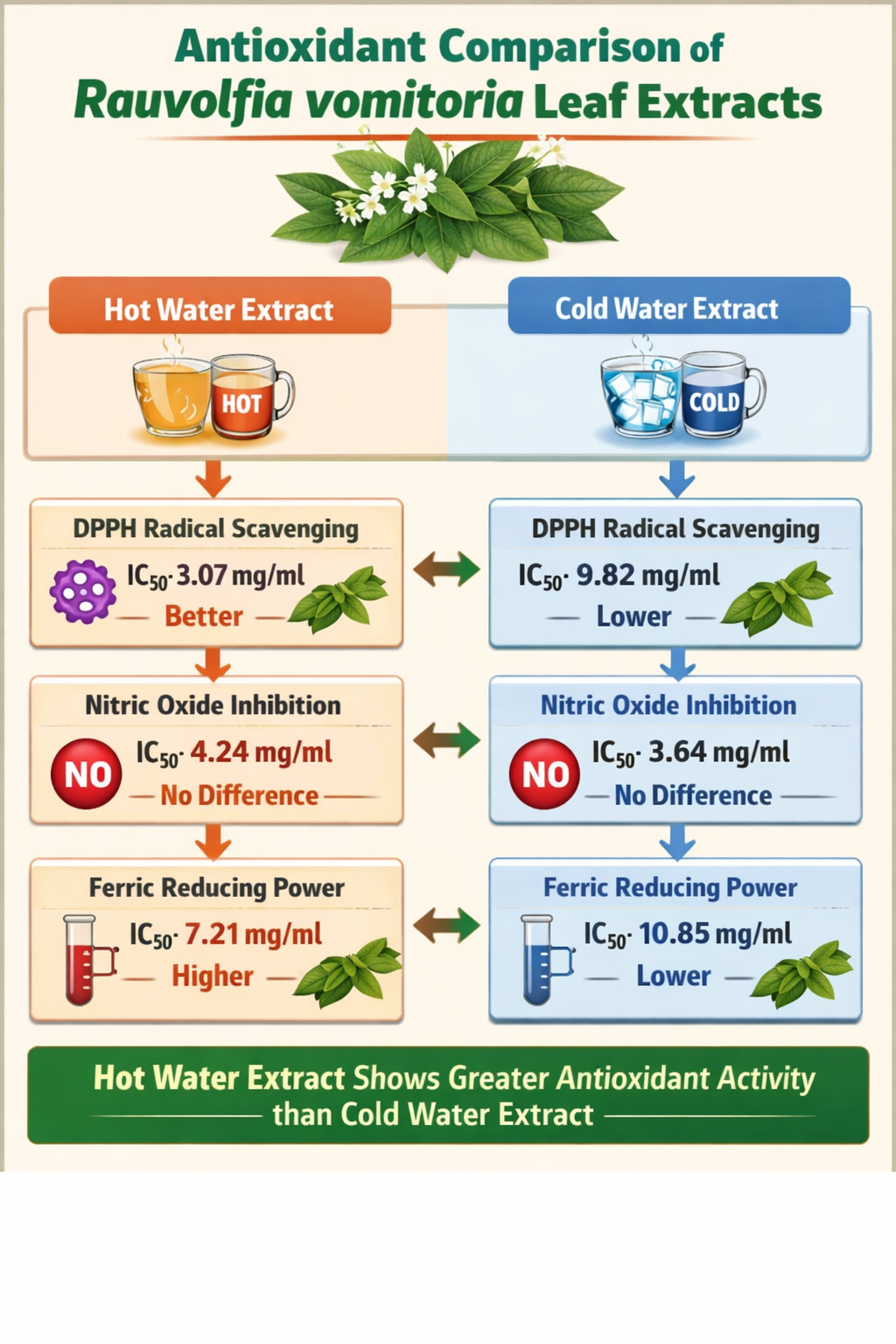
Rauvolfia vomitoria Afzel has attracted significant research interest due to its multiple health benefits. Its antioxidant properties are important in preventing oxidative stress, cancer, heart problems, and neurological disorders. This study compares the antioxidant capacity of R. vomitoria leaf extract in both hot and cold water. Standard methods were used to prepare leaf extracts in both hot and cold water, which were subjected to different antioxidant assays. The hot water leaf extract had a better capacity to snare free radicals produced by stable DPPH's free radical at 50% inhibition concentration (3.07 ± 0.54 mg/ml) than the cold water leaf extract (9.82 ± 0.01mg/ml). The nitric oxide inhibitory capacity of R. vomitoria at 50% inhibition concentration in cold and hot water leaf extract (3.64 ± 0.38 and 4.24 ± 0.11) showed no significant difference. The hot water leaf extract had higher ferric-reducing antioxidant power (IC50 of 7.21 ± 0.07 mg/ml) than the cold water extract (10.85 ± 0.50 mg/ml). The hot water leaf extract showed a higher total antioxidant capacity (IC50 of 6.01 ± 0.21 mg/ml) than the cold water extract (9.01 ± 0.07 mg/ml). These antioxidant evaluations show that R. vomitoria hot water leaf extracts were superior to cold water leaf extracts as antioxidants and free radical scavengers. The findings show that R. vomitoria's hot-water extract has greater antioxidant activity than its cold-water extract.
References
Agbodjogbé, K. W. D., Houngbeme, G. A., Oussouami, S. I., Tchikezo, M. and Messan, F. (2022). Phytochemistry, total polyphenol content and antiradical activity of Rauvolfia vomitoria (Apocynaceae) a plant used against asthma in Southern Benin. International Journal Advanced Research in Biological Science, 9(9): 127-136. DOI: http://dx.doi.org/10.22192/ijarbs.2022.09.09.012
Ahmed, S. and Beigh, S. H. (2009) Ascorbic acid, carotenoids, total phenolic content and antioxidant activity of various genotypes of Brassica Oleracea encephala. Journal of Medical and Biological Sciences, 3(1): 1-8.
Ajayi, O. A. (2021). Phytochemical and gc-ms analysis of bioactive components in ethanolic extract of Rauvolfia vomitoria leaves. Journal of the Chemical Society of Nigeria, 46(4): 0656 – 0660.
Akpojotor, P. and Ebomoyi, M. I. (2021). Investigating the anti-diabetic phytoconstituents Of Rauvolfia vomitoria leaves by Gas Chromatography-Mass Spectrometry (GC-MS). International Journal of Innovative Research and Advanced Studies, 8(5): 1-8.
Aliyu, A. B., Ibrahim, M. A., Musa, A. M., Musa, A. O., Kiplimo, J. J. and Oyewale, A. O. (2013). Free radical scavenging and total antioxidant capacity of root extracts of Anchomanes difformis engl. (araceae). Acta Poloniae Pharmaceutica- Drug Research, 70(1):115-121.
Bemis, D. L., Capodice, J. L, Gorroochurn, P., Katz, A. E. and Buttyan, R. (2006). Anti-prostate cancer activity of a β-carboline alkaloid enriched extract from Rauwolfia vomitoria. International Journal of oncology, 29: 1065-1073.
Chinonye, I. I., Chijioke, C., Iwuji, C. S., Ifeoma, O., Lynda, U. O., Augusta, U. A., Maureen, C. and Oluchukwu, E. M. (2021). Chemical and medicinal properties of rauwolfia vomitoria (afzel) harvested from the south eastern nigeria. Asian Journal of Chemical Sciences, 10(4): 56-71. DOI: 10.9734/AJOCS/2021/v10i419103
Chukwu, O., Orhevba, B. and Mahmood, B. (2010). Influence of Hydrothermal Treatments on Proximate Compositions of Fermented Locust Bean (Dawadawa). Journal of Food Technology, 8(3), 99-101. https://doi.org/10.3923/jftech.2010.99.101
Ekarika, C. J., Emmanuel, I. E., Anwanabasi, E. U. and Ubong S. B. (2020). Analysis of the Constituents of Rauwolfia vomitoria Ethanol Root Extract using GC-MS. World Journal of Innovative Research, 9(2): 32-34.
Erasto, P., Mbwambo, Z. H., Nondo, R. S. O., Lall, N. and Lubschagne, A. (2011). Antimycobacterial, antioxidant activity and toxicity of extracts from the roots of Rauvolfia vomitoria and R. caffra. Spatula DD, 1(2):73-80.
Fannang, S. V., Kuete, V., Mbazoa, C. D., Momo, J. I., Van-Dufat, H. T., Tillequin, F., Seguin, E., et al., (2011). A new acylated triterpene with antimicrobial activity from the leaves of Rauvolfia vomitoria. Chemical and Natural Compound, 47, 404.
Fatima, N., Baqri, S.S.R., Alsulimani, A., Fagoonee, S., Slama, P., Kesari, K.K., Roychoudhury, S. and Haque, S. (2021). Phytochemicals from Indian Ethnomedicines: Promising Prospects for the Management of Oxidative Stress and Cancer. Antioxidants, 10:1606-1609
Goodarzi, S., Rafiei, S., Javadi, M., Haghighian, H. k., Noroozi, S. A. (2018). Review on Antioxidants and Their Health Effects. Journal of Nutrition and Food Security, 3 (2): 106-112.
Hu, C., Zhang, Y. and Kitts, D. D. (2000). Evaluation of antioxidant and prooxidant activities of bamboo Phyllostachys niger Var. Henonis leaf extract in vitro. Journal of Agriculture Food and Chemistry, 48: 3170-3176.
Kumar, B., Kumar, S., Bajpai, V., & Madhusudanan, K. P., (2020). Phytochemistry of Plants of Genus Rauvolfia. CRC Press Boca Raton, Florida, United States.
Kumar, S., Bajpai, V., Singh, A., Bindu, S., Srivastava, M., Rameshkumar, K. B., & Kumar, B., (2015). Rapid fingerprinting of Rauwolfia species using direct analysis in real time mass spectrometry combined with principal component analysis for their discrimination. Analytical Methods, 7, 6021–6026.
Kumar, S., Kumari, D. and Singh, B. (2022). Genus Rauvolfia: A review of its ethnopharmacology, phytochemistry, quality control/quality assurance, pharmacological activities and clinical evidence. Journal of ethnopharmacology, 295:115327. Doi.10.1016/j.jep.2022.115327
Kumar, S., Singh, A., Bajpai, V., & Kumar, B., (2016a). Identification, characterization and distribution of monoterpene indole alkaloids in Rauwolfia species by orbitrap velos pro-mass spectrometer. Journal of Pharmacy and Biomedicals, 118, 183–194.
Lien, A. P., Hua, H. and Chuong, P. (2008). Free radicals, antioxidants in disease and health; review. International Journal of Biomedical Science, 4(2):89-96.
Manzocco, L., Anese, M. and Nicoli, M.C. (1998). Antioxidant properties of tea extracts as affected by processing. Lebens-mittel-Wissenschaft Und-Technologie, 31 (7–8), 694–698.
Marcocci, I., Marguire, J.J., Droy-lefaiz, M.T. and Packer, L., (1994). The nitric oxide scavenging properties of Ginkgo biloba extract. Biochemical Biophysical Research Communications, 201, 748–755.
Mier, S., Kanner, J., Akira, B. and Hdas, S. P. (1995). Antioxidation action of indole compounds during the autoxidation of linoleic acid. Eiyo Shokuryo, 19: 210-214.
Oghbaei, M. and Prakash, J. (2016). Effect of primary processing of cereals and legumes on its nutritional quality: A comprehensive review. Cogent Food and Agriculture, 2, 1136015. https://doi.org/10.1080/23311932.2015.1136015
Okereke, N. C., Iroka, F. C., Chukwuma, O. M., Kenneth, U. E. and Clement, U. O. (2015). The effect of boiling on the phytochemical and nutritional content of Rauvolfia vomitoria. Journal of Global Biosciences, 4(6): 2561-2568.
Owoade, A. O., Adetutu, A., Ogundipe, O. O. and Owoade, A. W. (2021). Hypolipidemic potentials of methanolic extract of rauvolfia vomitoria leaves in rats fed with high cholesterol. Asian Plant Research Journal, 8(4): 15-25.
Oyaizu, M. (1986). Studies on products of browning reactions: antioxidant activities of products of browning reaction prepared from glucosamine. Journal of Nutrition, 44: 307-315.
Pisoschi, A.M., and Negulescu, G.P. (2011). Methods for Total Antioxidant Activity Determination: A Review. Biochemistry and Analytical Biochemistry, 1(1):106-118.
Prieto, P., Pineda, M. and Aguilar, M. (1999). Spectrophotometric Quantitation of Antioxidant Capacity through the Formation of a Phosphomolybdenum Complex: Specific Application to the Determination of Vitamin E. Analytical Biochemistry, 269(2), 337-341.
Rahman, M., Badrul, I., Mohitosh, B. and Khurshid, A.H.M. (2015) In vitro antioxidant and free radical scavenging activity of different parts of Tabebuia pallida growing in Bangladesh. BMC Research Notes, 8:621.
Rathi, V. (2018). Herbal wine: Review. Journal of Nutrition and Weight Loss, 3(2): 1-7.
Sahira, K.B. and Catherine, L. (2015). General techniques involved in phytochemical analysis. International Journal of Advanced Research and Chemical Sciences, 2(4): 25-35.
Samuel T. A., James, A.B., Adebesin, O., Okafor, I. and Iwalokun, B. A. (2021). Phytochemical Investigation and Anti-Proliferative Effects of Rauvolfia vomitoria, Calliandra portoriscensis and Anthocleista djalonensis on Human Breast Cancer (MCF-7) Cell Line. African Journal of Biomedical Research, 24: 403- 411.
Sies, H. (1985). Oxidative stress. Academic Press, San Diego, Pg. 1-8.
Sofidiya, M.O., Jimoh, F.O., Aliero, A.A. Afolayan, A.J. Odukoya, O.A. and Familoni, O.B. (2012). Evaluation of antioxidant and antibacterial properties of six Sapindaceae members. Journal of Medicinal Plants Research, 6(1):154-160. Doi:/10.5897/jmpr11.1364.
Southon, S. and Faulks, R. (2002). Health benefits of increased fruit and vegetable consumption. In Fruit and Vegetable Processing: Improving Quality, 9th ed.; Jongen, W., Ed.; Woodhead Publishing Ltd.: Cambridge, UK, 1, pp. 2–20. ISBN 1855736640.
Sunil Kumar (2014) The Importance of antioxidant and their role in pharmaceutical science - A Review. Asian Journal of Reserch in Chemical and Pharmaceutical Sciences, 1: 27-44.
Surendran, S., Raju, R., Prasannan, P. and Surendran, A. (2021). A Comprehensive Review on Ethnobotany, Phytochemistry and Pharmacology of Rauvolfia L. (Apocynaceae). The Botanical Review, 87(3): 311-376. Doi:/10.1007/s12229-021-09262-2.
Van Boekel, M., Fogliano, V., Pellegrini, N., Stanton, C., Scholz, G., Lalljie, S., Somoza, V. Knorr, D. and Jasti, P. R. (2010). A review on the beneficial aspects of food processing. Molecular Nutrition and Food Research, 54(9) 1215–1247. [CrossRef] [PubMed]
Wolf G, (2005). The discovery of the antioxidant function of vitamin E: the contribution of Henry A. Mattill. Journal of nutrition, 135 (3): 363–366.
Yam, M. F., Basir, R., Asmawi, M. Z., RosidahAhmad, M. and Akowuah, G. A. (2008). Antioxidant and hepatoprotective activities of Elephantopus tomentosus ethanol extract. Pharmaceutical Biology, 46: 199-206.
Yu, J. and Chen, Q. (2014). Antitumor activities of Rauwolfia vomitoria extract and potentiation of gemcitabine effects against pancreatic cancer. Integrative cancer therapies, 13(3): 217-225.
Yu, J., Drisko, J. and Chen, Q. (2012). P01. 38. Anti-cancer activity of extracts from Rauwolfia vomitoria and Pao Pereira. BMC Complementary and Alternative Medicine, 12: 38-40.
Zhan, G., Miao, R., Zhang, F., Hao, X., Zheng, X., Zhang, H., Zhang, X., & Guo, Z., (2020b). Monoterpene indole alkaloids with diverse skeletons from the stems of Rauvolfia vomitoria and their acetylcholinesterase inhibitory activities. Phytochemistry, 177, 112450.
Zhan, G., Miao, R., Zhang, F., Hao, Y., Zhang, Y., Zhang, Y., Khurm, M., Zhang, X., & Guo, Z., (2020a). Peraksine derivatives with potential anti-inflammatory activities from the stems of Rauvolfia vomitoria. Fitoterapia, 146, 104704.
Downloads
Published
Issue
Section
License
Copyright (c) 2026 Malaysian Journal of Science (MJS)

This work is licensed under a Creative Commons Attribution-NonCommercial 4.0 International License.
Transfer of Copyrights
- In the event of publication of the manuscript entitled [INSERT MANUSCRIPT TITLE AND REF NO.] in the Malaysian Journal of Science, I hereby transfer copyrights of the manuscript title, abstract and contents to the Malaysian Journal of Science and the Faculty of Science, University of Malaya (as the publisher) for the full legal term of copyright and any renewals thereof throughout the world in any format, and any media for communication.
Conditions of Publication
- I hereby state that this manuscript to be published is an original work, unpublished in any form prior and I have obtained the necessary permission for the reproduction (or am the owner) of any images, illustrations, tables, charts, figures, maps, photographs and other visual materials of whom the copyrights is owned by a third party.
- This manuscript contains no statements that are contradictory to the relevant local and international laws or that infringes on the rights of others.
- I agree to indemnify the Malaysian Journal of Science and the Faculty of Science, University of Malaya (as the publisher) in the event of any claims that arise in regards to the above conditions and assume full liability on the published manuscript.
Reviewer’s Responsibilities
- Reviewers must treat the manuscripts received for reviewing process as confidential. It must not be shown or discussed with others without the authorization from the editor of MJS.
- Reviewers assigned must not have conflicts of interest with respect to the original work, the authors of the article or the research funding.
- Reviewers should judge or evaluate the manuscripts objective as possible. The feedback from the reviewers should be express clearly with supporting arguments.
- If the assigned reviewer considers themselves not able to complete the review of the manuscript, they must communicate with the editor, so that the manuscript could be sent to another suitable reviewer.
Copyright: Rights of the Author(s)
- Effective 2007, it will become the policy of the Malaysian Journal of Science (published by the Faculty of Science, University of Malaya) to obtain copyrights of all manuscripts published. This is to facilitate:
- Protection against copyright infringement of the manuscript through copyright breaches or piracy.
- Timely handling of reproduction requests from authorized third parties that are addressed directly to the Faculty of Science, University of Malaya.
- As the author, you may publish the fore-mentioned manuscript, whole or any part thereof, provided acknowledgement regarding copyright notice and reference to first publication in the Malaysian Journal of Science and Faculty of Science, University of Malaya (as the publishers) are given. You may produce copies of your manuscript, whole or any part thereof, for teaching purposes or to be provided, on individual basis, to fellow researchers.
- You may include the fore-mentioned manuscript, whole or any part thereof, electronically on a secure network at your affiliated institution, provided acknowledgement regarding copyright notice and reference to first publication in the Malaysian Journal of Science and Faculty of Science, University of Malaya (as the publishers) are given.
- You may include the fore-mentioned manuscript, whole or any part thereof, on the World Wide Web, provided acknowledgement regarding copyright notice and reference to first publication in the Malaysian Journal of Science and Faculty of Science, University of Malaya (as the publishers) are given.
- In the event that your manuscript, whole or any part thereof, has been requested to be reproduced, for any purpose or in any form approved by the Malaysian Journal of Science and Faculty of Science, University of Malaya (as the publishers), you will be informed. It is requested that any changes to your contact details (especially e-mail addresses) are made known.
Copyright: Role and responsibility of the Author(s)
- In the event of the manuscript to be published in the Malaysian Journal of Science contains materials copyrighted to others prior, it is the responsibility of current author(s) to obtain written permission from the copyright owner or owners.
- This written permission should be submitted with the proof-copy of the manuscript to be published in the Malaysian Journal of Science
Licensing Policy
Malaysian Journal of Science is an open-access journal that follows the Creative Commons Attribution-Non-commercial 4.0 International License (CC BY-NC 4.0)
CC BY – NC 4.0: Under this licence, the reusers to distribute, remix, alter, and build upon the content in any media or format for non-commercial purposes only, as long as proper acknowledgement is given to the authors of the original work. Please take the time to read the whole licence agreement (https://creativecommons.org/licenses/by-nc/4.0/legalcode ).