An Evaluation of The Impact of An Engineering Service-Learning Implementation on Learning
DOI:
https://doi.org/10.22452/mjs.vol45no1.7Keywords:
Engineering Service-Learning, engineering education system, student learning, learning approach, educational approachAbstract
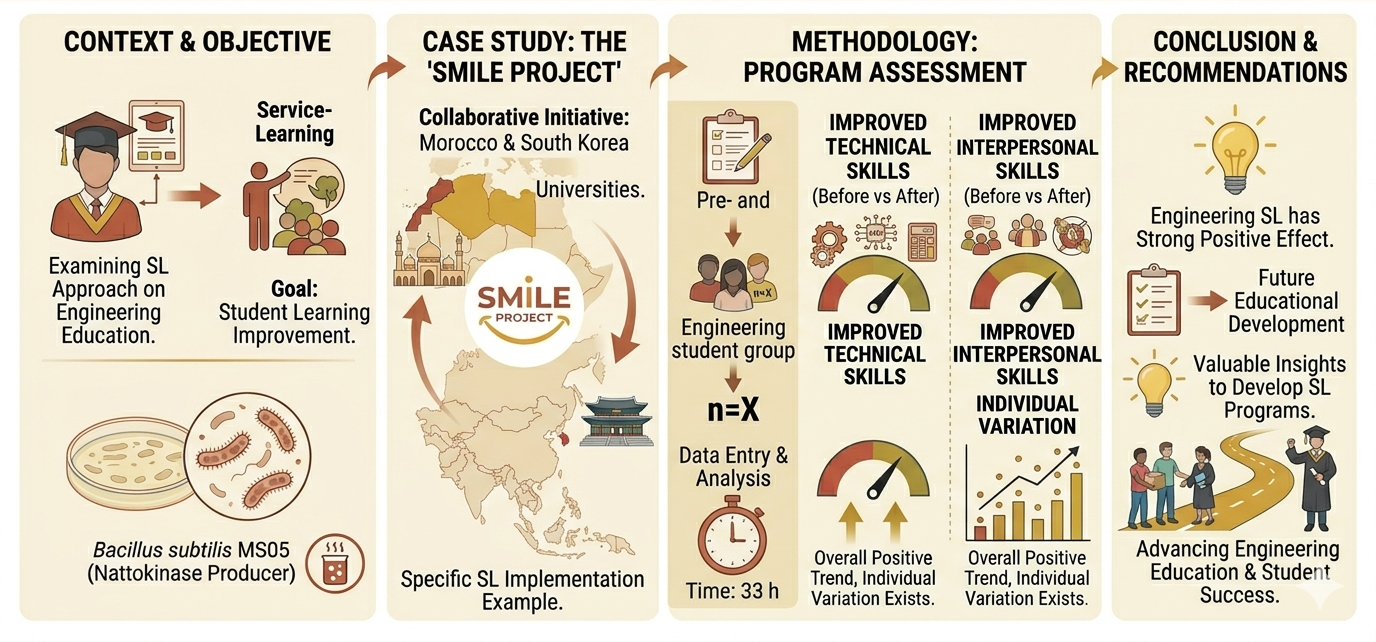
This study aims to examine the impact of the Service-Learning approach on the engineering education system and student learning. The study is conducted through the example of a specific implementation of this approach, namely the “Smile project,” a collaborative initiative between universities in Morocco and South Korea. This study also provides valuable insights and recommendations to further develop this educational implementation. To assess the effectiveness of the program in enhancing student learning, the study uses pre- and post-questionnaires administered to the participating students. The results of this analysis reveal a strong positive effect of engineering service-learning as a learning approach, improving both technical and interpersonal skills of engineering students. The impact on these skills, however, varies among individuals.
References
Cohen, Y., Ornoy, H., & Keren, B. (2013). MBTI Personality Types of Project Managers and Their Success: A Field Survey. Project Management Journal, 44(3), 78–87. https://doi.org/10.1002/pmj.21338
Dukhan, N., Schumack, M. R., & Daniels, J. J. (2008). Implementation of service-learning in engineering and its impact on students’ attitudes and identity. European Journal of Engineering Education, 33(1), 21–31. https://doi.org/10.1080/03043790701746132
Edwards, J. A., Lanning, K., & Hooker, K. (2002). The MBTI and Social Information Processing: An Incremental Validity Study. Journal of Personality Assessment, 78(3). https://www.researchgate.net/profile/Kevin-Lanning/publication/11235513_The_MBTI_and_Social_Information_Processing_An_Incremental_Validity_Study/links/58b0b212aca2725b5413e131/The-MBTI-and-Social-Information-Processing-An-Incremental-Validity-Study.pdf
Hedberg, E. C., & Ayers, S. (2015). The power of a paired t-test with a covariate. Social Science Research, 50, 277–291.
Hurley, A. E., Scandura, T. A., Schriesheim, C. A., Brannick, M. T., Seers, A., Vandenberg, R. J., & Williams, L. J. (1997). Exploratory and confirmatory factor analysis: Guidelines, issues, and alternatives. Journal of Organizational Behavior, 667–683.
Kaplan, R. M., & Saccuzzo, D. P. (2001). Psychological testing: Principles, applications, and issues. Wadsworth/Thomson Learning. https://psycnet.apa.org/record/2001-06953-000
Kusuma, D. W. Y., Raharjo, H. P., & Mugiyo, H. (2018). Personality Profiles Using MBTI Test for Sport Talent Identification for Students. International Seminar on Public Health and Education 2018 (ISPHE 2018), 168–171. https://www.atlantis-press.com/proceedings/isphe-18/25899771
Maloney, P., Dent, L., & Karp, T. (2013). A new method of assessing the effects of a service-learning class on engineering undergraduate students. International Journal for Service Learning in Engineering, Humanitarian Engineering and Social Entrepreneurship, 29–47.
Mowery, B. D. (2011). The paired t-test. Pediatric Nursing, 37(6), 320–322.
Oz-Medina, B. N. M., Blanco, S., & Alberti, M. G. (2021). Impact of service-learning on the motivation of engineering and high school students. International Journal of Engineering Education, 37(4), 1060–1070.
Queiruga-Dios, M., Santos Sánchez, M. J., Queiruga-Dios, M. Á., Acosta Castellanos, P. M., & Queiruga-Dios, A. (2021). Assessment methods for service-learning projects in engineering in higher education: A systematic review. Frontiers in Psychology, 12, 629231.
Riaji, T., El Hassani, S., & Alaoui, F. E. M. (2022). Application of paired samples t-test in engineering service-learning project. 2022 11th International Symposium on Signal, Image, Video and Communications (ISIVC), 1–4. https://doi.org/10.1109/ISIVC54825.2022.9800209
Ropers-huilman, B., Carwile, L., & Lima, M. (2005). Service-learning in engineering: A valuable pedagogy for meeting learning objectives. European Journal of Engineering Education, 30(2), 155–165. https://doi.org/10.1080/03043790410001664363
Samavedham, L., & Ragupathi, K. (2012). Facilitating 21st century skills in engineering students. The Journal of Engineering Education, 26(1), 38–49.
Taber, K. S. (2018). The Use of Cronbach’s Alpha When Developing and Reporting Research Instruments in Science Education. Research in Science Education, 48(6), 1273–1296. https://doi.org/10.1007/s11165-016-9602-2
Tavakol, M., & Dennick, R. (2011). Making sense of Cronbach’s alpha. International Journal of Medical Education, 2, 53.
Downloads
Published
Issue
Section
License
Copyright (c) 2025 Malaysian Journal of Science

This work is licensed under a Creative Commons Attribution-NonCommercial 4.0 International License.
Transfer of Copyrights
- In the event of publication of the manuscript entitled [INSERT MANUSCRIPT TITLE AND REF NO.] in the Malaysian Journal of Science, I hereby transfer copyrights of the manuscript title, abstract and contents to the Malaysian Journal of Science and the Faculty of Science, University of Malaya (as the publisher) for the full legal term of copyright and any renewals thereof throughout the world in any format, and any media for communication.
Conditions of Publication
- I hereby state that this manuscript to be published is an original work, unpublished in any form prior and I have obtained the necessary permission for the reproduction (or am the owner) of any images, illustrations, tables, charts, figures, maps, photographs and other visual materials of whom the copyrights is owned by a third party.
- This manuscript contains no statements that are contradictory to the relevant local and international laws or that infringes on the rights of others.
- I agree to indemnify the Malaysian Journal of Science and the Faculty of Science, University of Malaya (as the publisher) in the event of any claims that arise in regards to the above conditions and assume full liability on the published manuscript.
Reviewer’s Responsibilities
- Reviewers must treat the manuscripts received for reviewing process as confidential. It must not be shown or discussed with others without the authorization from the editor of MJS.
- Reviewers assigned must not have conflicts of interest with respect to the original work, the authors of the article or the research funding.
- Reviewers should judge or evaluate the manuscripts objective as possible. The feedback from the reviewers should be express clearly with supporting arguments.
- If the assigned reviewer considers themselves not able to complete the review of the manuscript, they must communicate with the editor, so that the manuscript could be sent to another suitable reviewer.
Copyright: Rights of the Author(s)
- Effective 2007, it will become the policy of the Malaysian Journal of Science (published by the Faculty of Science, University of Malaya) to obtain copyrights of all manuscripts published. This is to facilitate:
- Protection against copyright infringement of the manuscript through copyright breaches or piracy.
- Timely handling of reproduction requests from authorized third parties that are addressed directly to the Faculty of Science, University of Malaya.
- As the author, you may publish the fore-mentioned manuscript, whole or any part thereof, provided acknowledgement regarding copyright notice and reference to first publication in the Malaysian Journal of Science and Faculty of Science, University of Malaya (as the publishers) are given. You may produce copies of your manuscript, whole or any part thereof, for teaching purposes or to be provided, on individual basis, to fellow researchers.
- You may include the fore-mentioned manuscript, whole or any part thereof, electronically on a secure network at your affiliated institution, provided acknowledgement regarding copyright notice and reference to first publication in the Malaysian Journal of Science and Faculty of Science, University of Malaya (as the publishers) are given.
- You may include the fore-mentioned manuscript, whole or any part thereof, on the World Wide Web, provided acknowledgement regarding copyright notice and reference to first publication in the Malaysian Journal of Science and Faculty of Science, University of Malaya (as the publishers) are given.
- In the event that your manuscript, whole or any part thereof, has been requested to be reproduced, for any purpose or in any form approved by the Malaysian Journal of Science and Faculty of Science, University of Malaya (as the publishers), you will be informed. It is requested that any changes to your contact details (especially e-mail addresses) are made known.
Copyright: Role and responsibility of the Author(s)
- In the event of the manuscript to be published in the Malaysian Journal of Science contains materials copyrighted to others prior, it is the responsibility of current author(s) to obtain written permission from the copyright owner or owners.
- This written permission should be submitted with the proof-copy of the manuscript to be published in the Malaysian Journal of Science
Licensing Policy
Malaysian Journal of Science is an open-access journal that follows the Creative Commons Attribution-Non-commercial 4.0 International License (CC BY-NC 4.0)
CC BY – NC 4.0: Under this licence, the reusers to distribute, remix, alter, and build upon the content in any media or format for non-commercial purposes only, as long as proper acknowledgement is given to the authors of the original work. Please take the time to read the whole licence agreement (https://creativecommons.org/licenses/by-nc/4.0/legalcode ).