Soil Preference and Burrow Characteristics of Two Theraphosidae Species in Penang Island, Malaysia
DOI:
https://doi.org/10.22452/mjs.vol45no1.1Keywords:
Arachnid, Burrow structure, Tarantula, Soil characteristicAbstract
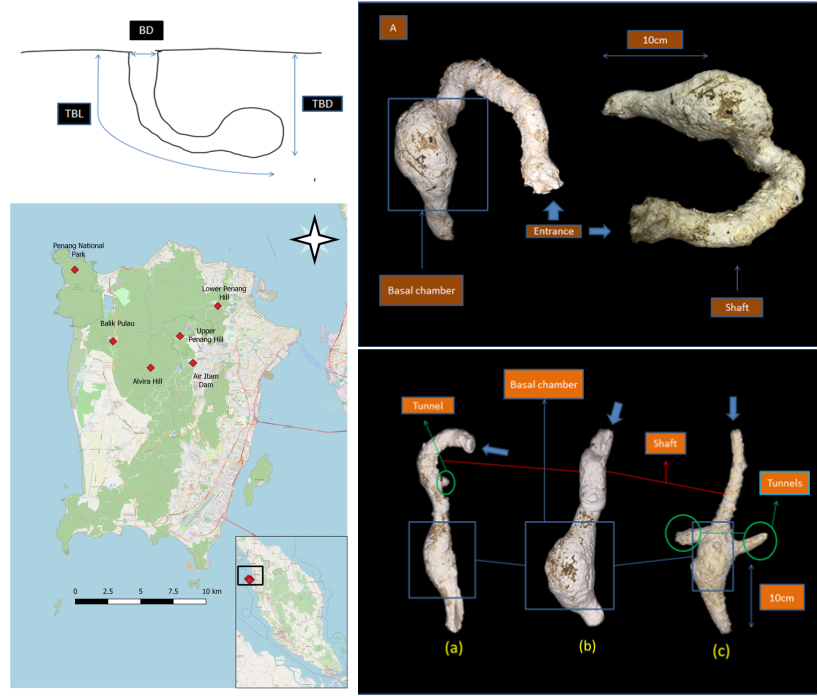
Tarantulas play a crucial role in maintaining ecological balance by regulating insect populations. However, little is known about the soil preferences and burrow structures of tarantulas in Malaysia. This study aims to determine the soil preference as well as the burrow structure of Coremiocnemis cunciularia and Chilobrachys andersoni from Penang Island. The soil characteristics of the soil samples collected around the burrows of Coremiocnemis cunciularia (n = 30) and Chilobrachys andersoni (n = 30) were determined using soil texture analysis. The measurements and burrow structures from adults and juveniles of Coremiocnemis cunciularia and Chilobrachys andersoni were determined. It was revealed that the moisture content and clay percentage in the soil samples around burrows of Chilobrachys andersoni and Coremiocnemis cunicularia were significantly different. Meanwhile, there is some variation in the structure and measurements of the burrows of the two tarantula species. The findings in this study could be useful for the conservation works and habitat management of tarantulas on Penang Island.
References
Bertani R. (2013). A new species of Melloina (Araneae: Paratropididae) from Venezuela, Zoologia (Curitiba) 30: 101-106.
Canning G., Reilly B., Dippenaar-Schoeman A. (2014). Burrow structure and microhabitat characteristics of Nesiergus insulanus (Araneae: Theraphosidae) from Frégate Island, Seychelles, Journal of Arachnology 42: 293-298.
Chakraborty S. K. (2017). Ecological services of intertidal benthic fauna and the sustenance of coastal wetlands along the Midnapore (East) Coast, West Bengal, India. In C. Finkl & C. Makowski (Eds), Coastal Wetlands: Alteration and Remediation (pp 777-866). Springer, Cham.
HILS J. M., Hembree D. (2015). Neoichnology of the burrowing spiders Gorgyrella inermis (Mygalomorphae: Idiopidae) and Hogna lenta (Araneomorphae: Lycosidae), Palaeontologia Electronica 18: 1-62.
Lapinski W., Gabriel R., Pérez-Miles F. (2018). Description of the female of Ami bladesi Pérez-Miles, Gabriel & Gallon, 2008 (Araneae: Theraphosidae), with notes on its distribution, ecology, and behaviour, Arachnology 17: 419-426.
Machkour-M’rabet S., Hénaut Y., Sepúlveda A., Rojo R., Calmé S., Geissen V. (2007). Soil preference and burrow structure of an endangered tarantula, Brachypelma vagans (Mygalomorphae: Theraphosidae), Journal of Natural History 41: 1025-1033.
Marnell C. (2016). Tarantula and hermit crab emergency care. Veterinary Clinics of North America. Exotic Animal Practice 19: 627–646.
Mugot D. A., Piloton Q. A., Ansigbat V. V., Ascaño II C. P. (2021). Inventory and habitat preference of pteridophytes in and around gold‐mined areas in Gango, Libona, Bukidnon, Philippines, Journal of Ecosystem Science and Eco-Governance 3: 47-53.
Pérez-Miles F., Costa F. G., Toscano‐Gadea C., Mignone A. (2005). Ecology and behaviour of the ‘road tarantulas’ Eupalaestrus weijenberghi and Acanthoscurria suina (Araneae, Theraphosidae) from Uruguay, Journal of Natural History 39: 483–498.
Pocock R. I. (1900). Fauna of British India, including Ceylon and Burma. Arachnida. Taylor and Francis.
Kędzior R., Kosewska A. (2022). Landscape heterogeneity determines the diversity and life history traits of ground beetles (Coleoptera: Carabidae), Sustainability 14: 13980.
Salman A., Jaafar M., Mohamad D. (2021). Ecotourism development in Penang Hill: A multi-stakeholder perspective towards achieving environmental sustainability, Environmental Science and Pollution Research 28: 42945–42958.
Simon E. (1903). Histoire naturelle des araignées. Paris.
Thorell T. (1891). Spindlar från Nikobarerna och andra delar af södra Asien, Kongliga Svenska Vetenskaps-Akademiens Handlingar 24: 1-149.
Viana T. A., Martins F. M., Lourenço A. P. (2021). The orchid bee fauna (Hymenoptera: Apidae: Euglossini) of a Neotropical Savanna: An efficient protocol to assess bee community and diversity along elevational and habitat complexity gradients, Neotropical Entomology 50: 748–758.
West R. C., Nunn S. C., Hogg S. (2012). A new tarantula genus, Psednocnemis, from west Malaysia (Araneae: Theraphosidae), with cladistic analysis and biogeography of Selenocosmiinae Simon 1889, Zootaxa 3299: 1-43.
Wilson J. S., Gunnell C. F., Wahl D. B., Pitts J. P. (2012). Testing the species limits of the tarantulas (Araneae: Theraphosidae) endemic to California's Southern Coast Ranges, USA, Insect Conservation and Diversity 6: 365-371.
Yáñez M., Floater G. (2000). Spatial distribution and habitat preference of the endangered tarantula, Brachypelma klaasi (Araneae: Theraphosidae) in Mexico, Biodiversity & Conservation 9: 795–810.
Qureshi N., Saher N. (2012). Burrow morphology of three species of fiddler crab (Uca) along the coast of Pakistan, Belgian Journal of Zoology 142: 114-126.
Downloads
Published
Issue
Section
License
Copyright (c) 2026 Malaysian Journal of Science (MJS)

This work is licensed under a Creative Commons Attribution-NonCommercial 4.0 International License.
Transfer of Copyrights
- In the event of publication of the manuscript entitled [INSERT MANUSCRIPT TITLE AND REF NO.] in the Malaysian Journal of Science, I hereby transfer copyrights of the manuscript title, abstract and contents to the Malaysian Journal of Science and the Faculty of Science, University of Malaya (as the publisher) for the full legal term of copyright and any renewals thereof throughout the world in any format, and any media for communication.
Conditions of Publication
- I hereby state that this manuscript to be published is an original work, unpublished in any form prior and I have obtained the necessary permission for the reproduction (or am the owner) of any images, illustrations, tables, charts, figures, maps, photographs and other visual materials of whom the copyrights is owned by a third party.
- This manuscript contains no statements that are contradictory to the relevant local and international laws or that infringes on the rights of others.
- I agree to indemnify the Malaysian Journal of Science and the Faculty of Science, University of Malaya (as the publisher) in the event of any claims that arise in regards to the above conditions and assume full liability on the published manuscript.
Reviewer’s Responsibilities
- Reviewers must treat the manuscripts received for reviewing process as confidential. It must not be shown or discussed with others without the authorization from the editor of MJS.
- Reviewers assigned must not have conflicts of interest with respect to the original work, the authors of the article or the research funding.
- Reviewers should judge or evaluate the manuscripts objective as possible. The feedback from the reviewers should be express clearly with supporting arguments.
- If the assigned reviewer considers themselves not able to complete the review of the manuscript, they must communicate with the editor, so that the manuscript could be sent to another suitable reviewer.
Copyright: Rights of the Author(s)
- Effective 2007, it will become the policy of the Malaysian Journal of Science (published by the Faculty of Science, University of Malaya) to obtain copyrights of all manuscripts published. This is to facilitate:
- Protection against copyright infringement of the manuscript through copyright breaches or piracy.
- Timely handling of reproduction requests from authorized third parties that are addressed directly to the Faculty of Science, University of Malaya.
- As the author, you may publish the fore-mentioned manuscript, whole or any part thereof, provided acknowledgement regarding copyright notice and reference to first publication in the Malaysian Journal of Science and Faculty of Science, University of Malaya (as the publishers) are given. You may produce copies of your manuscript, whole or any part thereof, for teaching purposes or to be provided, on individual basis, to fellow researchers.
- You may include the fore-mentioned manuscript, whole or any part thereof, electronically on a secure network at your affiliated institution, provided acknowledgement regarding copyright notice and reference to first publication in the Malaysian Journal of Science and Faculty of Science, University of Malaya (as the publishers) are given.
- You may include the fore-mentioned manuscript, whole or any part thereof, on the World Wide Web, provided acknowledgement regarding copyright notice and reference to first publication in the Malaysian Journal of Science and Faculty of Science, University of Malaya (as the publishers) are given.
- In the event that your manuscript, whole or any part thereof, has been requested to be reproduced, for any purpose or in any form approved by the Malaysian Journal of Science and Faculty of Science, University of Malaya (as the publishers), you will be informed. It is requested that any changes to your contact details (especially e-mail addresses) are made known.
Copyright: Role and responsibility of the Author(s)
- In the event of the manuscript to be published in the Malaysian Journal of Science contains materials copyrighted to others prior, it is the responsibility of current author(s) to obtain written permission from the copyright owner or owners.
- This written permission should be submitted with the proof-copy of the manuscript to be published in the Malaysian Journal of Science
Licensing Policy
Malaysian Journal of Science is an open-access journal that follows the Creative Commons Attribution-Non-commercial 4.0 International License (CC BY-NC 4.0)
CC BY – NC 4.0: Under this licence, the reusers to distribute, remix, alter, and build upon the content in any media or format for non-commercial purposes only, as long as proper acknowledgement is given to the authors of the original work. Please take the time to read the whole licence agreement (https://creativecommons.org/licenses/by-nc/4.0/legalcode ).